Brrrrrrrr!
Well, the cold weather finally
made it here to Central Texas this past week.


It was so cold the other night it completely froze my bubble fountain!
Okay, so it wasn’t that cold, but in these shots of bubbling water the
camera does make the “bubbling” appear more like solid ice.
Can you spot the gorilla in the second image?
(Thanks sandowl).
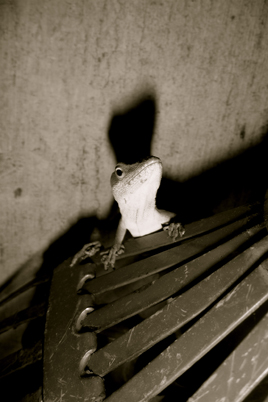
Even my pond toad looks like he is cold. Either that or he is
having a heart attack. I hope he dosn’t ‘croak’ (ahem).


Staying with the pond for one moment:
Remember in my earlier post about cattails, more specifically, when they drained this pond to within a few inches? Well, can you believe it, they are at it once again!
I decided to leave a couple of the green stalks standing when I performed my last documented cattail cull – big mistake. This was the scene when I walked outside today. The stalk hanging over the pond was yet again lying horizontally and dangerously close to the water spout. Ground Hog day!
I got lucky this time, now where are my rubbish, and I do mean rubbish clippers?

And now for a plant with a name fitting for this recent cold snap…

Delosperma ‘sesotho pink’
or ‘Trailing Ice Plant’ situated in front of my “holey” rocks. (Vs 5-11).

Ice plant is a sparkling evergreen succulent from South Africa. One of the most drought resistant plants, in CA it is often planted along roadsides where it is fire retardant and an excellent soil binder. It takes the Texas heat well and needs very little water to keep looking good. The flowers are the most brilliant aspect of this plant, with the production of a great quantity of abundant and long-lasting magenta flowers that will cover a large area, hence the popular name “pink carpet”. . .roll on the spring!
I forgot to add – it is also attracts butterflies!
Picture from:
www.landscapedesignbymjm.com/plants.html


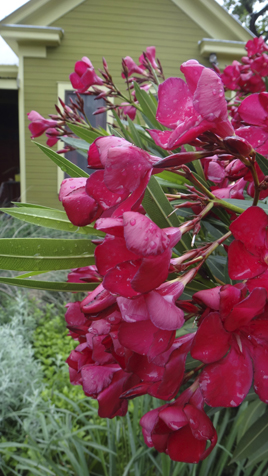
This Malephora ‘Red Rum’ (also an ice plant)
is in full bloom right now and spreading out nicely in my new middle bed. These two plants were
labeled the same but clearly have different petal shapes and hues.

Some more reds…
Now these will warm your cockles if eaten raw on a cold winters night. We have had a constant supply of these cayenne peppers over the last few months. They are also a great test of patience for young children…
“no, you have to wait for it to turn red, then you can pick it”.
(Repeat every day, five times a day, until the pepper turns red).


Looking like a vibrant orange jelly bean, this ornamental pepper is also still packing a punch in the heart of the winter.

Warning!
The next segment contains a human being devouring some raw zebra meat, be warned…continue at your own risk…

I have an agave under my Vitex tree in my front yard that has now got inch long spikes on it. I usually don’t worry about these needles as most of my agaves are in a bed that is strictly out of bounds and enclosed by moss boulders. This one is in the open, this one is at the exact eye level of my youngest, this one is going to get snipped. As I was going around this plant with my rubbish pruners, attempting to snip off the sharp needles, I remembered watching an episode of Bear Grylls http://www.beargrylls.com/ teaching some of his survival skills. The two images above are the remains of the tip of the agave after I had ripped out the needle from it’s base then pulled. I could feel the fibres releasing from deep within the leaf, it felt rather like small tendons snapping. Why am I doing this you ask?


Talking of tendons snapping…
(What? I did warn you) …here is Mr Grylls ‘fine dining’
in one of his favorite eateries! Brrrr!
Well If you should find yourself stranded in the wild, in an environment which is capable of growing Agave plants, this little survival tip may save your life, but I very much doubt it. Anyway I decided to give this a try, and I don’t mean eating rather tough parts of a decaying zebra. (Some more ‘Brrrring’ followed by an involuntary knee jerk).

Lecter: What became of your lamb err..zebra, Mr Grylls?
Bear Grylls: I ate it.
Lecter: You still wake up sometimes, don’t you? Wake up
in the dark and wonder why you would devour such a thing on public TV?
Bear Grylls: No.

Here is a close up of the agave “needle” and here it is with the thread attached. I think I could get double this about of thread if I was more careful during the ‘extraction phase’. The thread was still very green and fresh so I decided to let it dry out a day or two…


Here is the end result; natures very own, and extremely strong needle and thread, even better the thread is already attached to the needle…no more fidgeting or good eyesight required.
It is probably a little large and thick for most modern garments, but hey, if your favorite attire is say a medieval tunic, or a hessian sack with a couple of holes cut out for your arms, you would be hard pressed to beat it for general darning purposes.

You could even perform some rudimentary stitching of wounds with it…


Look at these arteries on some decaying leaves on my shrimp plant. “Yes, Yes!”
Justicia brandegeana is native to Mexico.
It is often grown in tropical and subtropical gardens, and has escaped cultivation
and naturalized in peninsular Florida.

Here is a shrimp bloom shortly before I skewered it and threw it on the barbie. After
taking these shots I finally chopped the now 4ft leggy stalks back to the ground to
allow the plant to gather some energy for next years langoustine harvest. And why do
I hate my brand new pruners?
Well look at them now:


I had to put tape on the locking mechanism to stop it engaging every time I squeezed the handles together, aargghh, so irritating.
Now, because they are always in the open position they are no longer ‘pocketable’ for fear of them pruning something I most definitely don’t want pruned.

My first baby gophers are beginning to emerge, break out the cigars:

Gopher plant Euphorbia biglandulosa
This plant is already way ahead of the crowd, already sending up next years spiraling madness. I am going to need about ten of these plants in the spring, to line the perimeter of my new middle succulent bed. Has anyone propagated this plant? if so, please tell me how you did it?


Oxalis, Wood Sorrel…is in full bloom right now under my giant timber bamboo. I have burgundy and green.

World wide there are about 800 species of this little plant. The scientific name Oxalis comes from the Greeks and means “sharp” and the common name “Sorrel” means “acidic” or “sour”. Both refer to the taste of the plant.
Medical Uses: This plant can quench thirst and it has been touted for its ability to heal sores especially of the mouth, but old sores and “cancers” on the skin as well. It has also been used to cool fevers and treat urinary problems.
So, if you are feeling dehydrated due to your mouth sores, running an irritating low-grade fever, and frequently finding yourself ‘simply having to go,’ this is the plant you should consider mass planting.
One word of warning though (this is where it starts sounding like a tv Ad)… this plant contains oxalic acid which is toxic in very large doses! Oxalic acid can precipitate in the kidneys as calcium oxalate crystals, forming an estimated 80% of kidney stones…I knew I should have not devoured all my plants in one sitting just because I was tad thirsty.

Crassula arborescens
or Silver Dollar Plant, Beestebul, Jade Plant, Jade Tree, Money Tree is an introduced plant in Hawaii and has become naturalized.
It is also from S.Africa.
Like many succulents, they are slow growers. It may take 20 years to reach 3 feet in height, providing it lives through our hot august nights and occasional hard freezes in central Texas. In ideal conditions this succulent shrub can grow up to 10 feet tall! I had no idea these could get so big.


My side cactus and succulent bed is still looking quite full. The exploding sotol in the background has finally reached a mature size. The right picture will be the home of my future carved cactus ‘faces’. I have been ‘plumping’ these cactus up, (pulling off their expansion growths) to swell the base node before the carving, it is taking ages!
The verbena is clambering its way between my moss boulders, it has also bloomed sporadically all through the winter.

And finally…


My donkey ear pups that I propagated have lived on through the freezing temperatures whilst both their parents froze completely to the ground. I thought for sure these little guys would have turned to mush, having only been planted only a couple of months ago.
Stay Tuned For:
“Yo Ho Ho and a Barrow of Cactus”
All material © 2009 for east_side_patch. Unauthorized reproduction prohibited.