Lots to do, lots to do.
In preparing for the upcoming tour I started with the big stuff, my philosophy being the big stuff a) takes longer and b) generally generates a lot more mess. This included the chopping down of the dead giant timber bamboo, the pruning of trees and yes, yet another delivery of granite. I plan to finish with the small cosmetic toppings, the “hide it under the carpet” mulch, cake sprinkles etc. One area I do not need to worry about are these bamboo muhly’s
Muhlenbergia dumosa
 that flank the approach into my front garden from the street. Considering that I only planted this drift at the start of this year they have done really well, this plant loves Hell-Strips. I have read in different places that this grass is slow growing, mmm really? And these were planted in the worst soil ever! These “Muhli” work really well to hide and soften this concrete walkway (a place where no weeds can exist, although Bermuda grass naturally tries) and like my Mexican feather grasses on steroids, they add some fantastic hazy animation to any scene with only the slightest of breezes. A Texas tough, deer resistant ornamental grass, plant it to catch the westerly setting sun for a serious late afternoon light show, you will not be disappointed!
 As an added visual bonus the color of these grasses perfectly match the colors of our house.
Staying front side, this welcome mound mysteriously appeared overnight. I can only surmise that a member of the Naboo called it in to Custom Stone with a high pitched series of clicks and clacks. The tribe has been laying low since I informed them about the tour…I fear they might be plotting something as all the spiny seed pods on my datura have suddenly vanished.
 With a cold front blowing through central Texas I scurried out to get my old wheelbarrow, on seeing the mound of granite, it predictably released all the air from its lone tire in future hauling defiance. My wheelbarrow is quite geriatric at this point, it has splits in its joints, lost bolts on its front wheel (which causes the wheel to erratically move left and right when in motion) and it groans constantly with a full load like a

This groaning increases in volume depending how much substrate you dare to put in it. I know exactly how much my old friend can handle at this point, I feared this latest mound of decompose granite may cause it to finally keel over, exhaling it’s final rubbery breath out of it’s wobbly tire, but it prevailed once again.

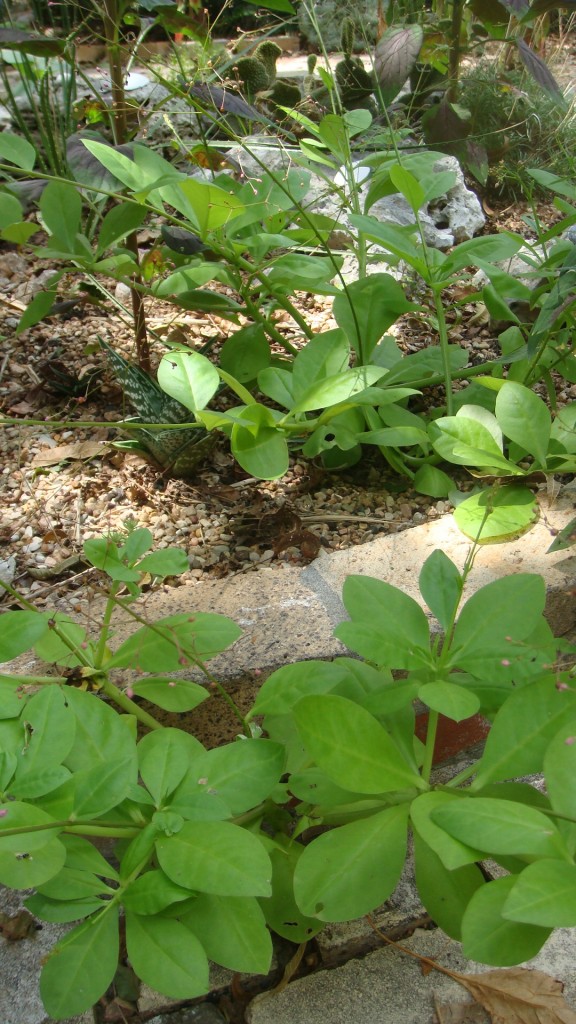
Weed suppressant laid down, granite administered, mounds developed. Here is my neighbor’s new Hell Strip, a bit sparse I know, but it sure is an improvement on what it was. I have a bunch of seeds planted in here, it will be fun to see what emerges. Changing flat weedy Hell-Strips, one strip at a time.

My Hell Strip side has filled in pretty well considering it was also only started early this year,
 the Blackfoot daises have gone berserk with all our recent moisture…

…this plant provides great summer color, the colors and “yolk” of this daisy pair very well with bulbine, another Texas trooper.

Also in the Hell-Strip my bluebonnet seeds that my hobbits and I spent an entire afternoon shelling (Thanks RR http://wwwrockrose.blogspot.com/) have broken through the top crust of granite…I know you are supposed to just scatter them topside then stomp them in, but I could see my local mockingbirds licking their beaks as soon as I went out front to disperse my small bowl of seeds. Determined to give them a fighting chance I scraped my heel across the granite and made sure to bury them, just a little. Interestingly they just popped up the top layer of granite as they grew in small tectonic plates.
Some final front shots…

Salvia leucantha is in full fuzzy flight, and my magenta and white celosia seed heads…
 …just keep snaking their way further and further toward the ground. A lot of these have already started to drop seed, already prematurely seeding the next generation! They are ruining my annual seed gathering custom with their accelerated aging, oh well, I have plenty more “normal ones” to harvest.

And finally Gregg’s mist flower, basket grass (right) and artemesia (top)…provide great silvery-blue color.

Moving On…

I witnessed a tree fern strangling this poor miscanthus seed head…

…and an infestation which fell on me like ash as I brushed against it to do some trimming. At first I thought it was some sort of scale…
 but on closer inspection it was equally as bad…Whiteflies!
Hemiptera Aleyrodidae
 And they were amassing a despicable army on the underside of the leaves on my white pomegranate tree. Without magnification these minute insects resemble flying dandruff. With magnification they look like moths but in fact they are closer related to scale insects…I knew it! Both adult and nymphs feed by sucking plant juices, sticky honeydew excreted by the flies creates mold that then interferes with photosynthesis, which retards plant growth causing leaf drop. Not good.
While I was messing around taking these shots I decided to pull on some vines that were growing up into an adjacent conifer, I dislodged one of these…

and immediately received one of these:

I could have been stung a lot more as it took me a while to dance around my sotol and perform a strange sideways shuffle around a large agave to emerge, hopping in a very John Cleese fashion over a moss boulder to the open safety of one of my pathways.

We finished up the week with a visit to my favorite Austin event: “The Mediterranean Festival,” where some crazy Geek…I mean Greek dancing ensued:

Great music, a truly “capital” event.

Imagine if they had used bamboo scaffolding!
Stay Tuned for:
“Maverick”
All material © 2010 for eastsidepatch. Unauthorized
intergalactic reproduction strictly prohibited, and
punishable by late (and extremely unpleasant)
14th century planet Earth techniques.
Inspirational “light” reading of the week:
Nerd Alert…Nerd Alert…Ne

This fascinating concept comes from a graduate student project at the Bartlett School of Architecture in London several years ago entitled Growing a Hidden Architecture. Christian Kerrigan proposed an awe-inspiring series of contraptions: collars, tourniquets, hinges, corsets, and belts that could be attached to still-growing trees, thus bending and shaping their growth into a functioning, sea-ready ship. Christian Kerrigan investigates how man’s ability to control his surroundings is intimately linked with his advancing capabilities of using technology. Christian says “We have reached a point in our evolution where we are now capable of creating design criteria to manipulate natural growth and development.” Here are a some inspiring drawings he produced to visualize his concept.
All images are from “Growing A Hidden Architecture” by Christian Kerrigan
 Copse View: as the trees slowly evolve the ‘Amber clock’ strapped to the tree registers the passing of time with a two hundred year hourglass.
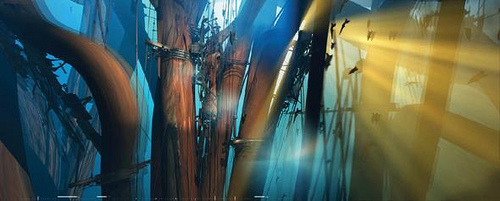
“By controlling the manipulation of refined armatures, calibrating devices and designed corsets,” Kerrigan writes, “the system is capable of controlling the growth of a ship inside the forest. The ship will grow over a period of 200 years and will exist as a hidden architecture inside the trees. The ship growing in the forest is the ship from the ‘Rime of the Ancient Mariner,’ a tale of man’s relationship to mortality.” In a particularly fantastic detail, “the artificial system harvests resin from the trees to measure time passing”:
Slowly growing to completion, the end of the system within the forest is signaled by the Amber Clock, the resin cycles in the trees keeping time. The armatures alter the geometries of the copse with technologies, which are spliced into the hull of the ship.

Macresco: The corset strapped around the tree creates the formwork for the extruded hull section
The ship growing in the forest is the ship from the ‘Rime of the Ancient Mariner’, a tale of man’s relationship to mortality.
For the evolution to last without human intervention, the artificial system harvests resin from the trees to measure time passing. The hourglass is designed to a volume of two hundred years, as the resin passes from the tree the clock slowly fills. Ultimately the hourglass volume is filled, jamming the clock signally the completion of the system. The project demonstrates by creating this architecture within the trees the artificial system itself extends new possibilities into the relationship between technology and nature.
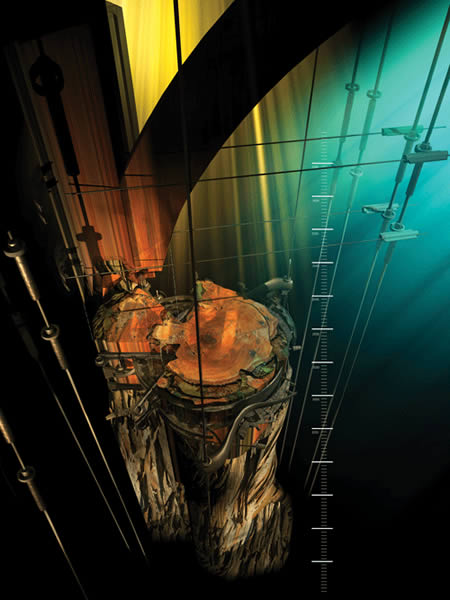
Tree evolution: As the forest matures the ‘Amber clock’ is consumed with the body of the trees. It acts as an artifact for the artificial system of manipulation.
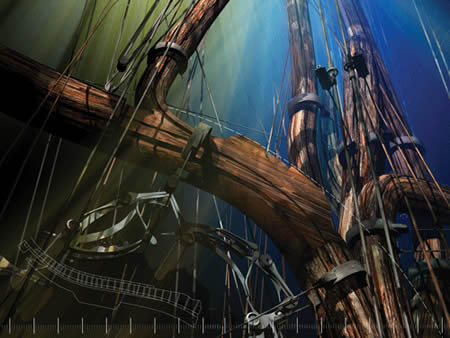
Hull section: As the trees grow the manipulation of the hull section evolves as a trained section inside the tree.
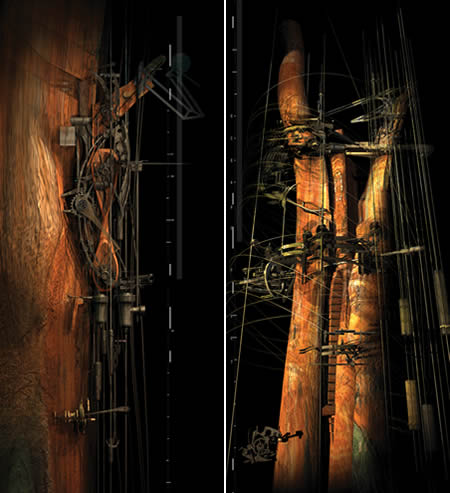
Amber Clock (left): Ships Figurehead (right): This the carved ornamental and painted figure erected on the bow of ships. In this system it evolves from the splitting of the tree as an iconographic piece of a symbiotic relationship between nature and technology.
Kerrigan’s vision of a ship self-assembling through carefully restricted tree growth really captures the imagination.
Here is another project with similar (Ahem) roots…
Growth Assembly…
Growth Assembly – Alexandra Daisy Ginsberg & Sascha Pohflepp from Sascha Pohflepp on Vimeo.
This project by artist Sascha Pohflepp examines a similar idea to Kerrigan’s, but it includes the added caveat of gene-splicing…proposing that genetically “modified” plants could sprout machine-parts instead of conventional fruit and nuts to act as components to build “things”, like the featured herbicide sprayer.
Finally:
lets get through the ‘Rime of the Ancient Mariner’ together, we can do this.
So go grab your favorite libation, put your feet up, take a few deep breaths…here is part one:
The poem may have been inspired by James Cook’s second voyage of exploration (1772–1775) of the South Seas and the Pacific Ocean. It is the longest major poem by the English poet Samuel Taylor Coleridge, written in 1797–98.
The poem is a tale of man’s relationship to mortality.