Okay perhaps the wind is not so much shaking the barley as it is shaking these
inland sea oats, (I have no barley after all). These swaying sea oats really give the
sense that fall is only just around the corner, even though I know we
traditionally have our hottest month to still endure. I can but imagine.
Still, watching these seeds dance in the wind makes me feel
that there is light at the end of a particularly parched Texas summer tunnel.

Even this This ‘skimmer’ Dragon, Common Whitetail (Plathemis lydia),
(only the second I have ever seen in my garden), seems to be adorning a fine fall suit, with brass buttons.
I caught this one sunning itself in my mexican bush sage.


I took these with the flash on, which really seems to bring out the iridescence on the wings,
although the true wing coloration is lost. (Without flash, right image).

“Honey, I’ve shrunk the Agave americana variegata”!

Today I decided to do some thinning. The above image was a mighty
fine example of a containered Agave americana variegata.
Over the years this plant has shrunk, partly due to neglect
and more certainly to self suffocation.
Too many pups, not enough container!
Like a good parent this plant has sacrificed itself for the development
and well-being of it’s offspring. The plant was in decline.


Here it is before I thinned it out, and here it is in a much calmer
state afterward, ready to climb once again, to new,
uncluttered agave heights.

The best thing about an agave container thinning?
Is the pups…any long term readers will know I have a hard time not planting all of them.
Oh, and I will make room for these, come Hell or high water,
the latter of which is as unlikely… as a really unlikely thing
here in central Texas.
Have you seen the current conditions of the Pedernales river, err I mean trickle?
This is one of the only plants that I would even consider planting at this brutal time of year.

“El Niño” “El Niño” “El Niño” “El Niño” “El Niño”

But until the water gods return..
The chores for Miss Ingalls will continue!


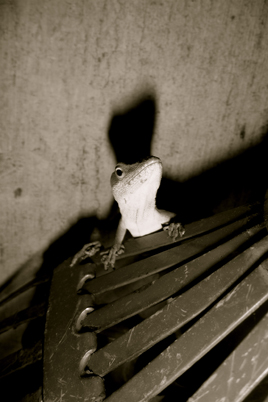
This Jurassic anole was intensely eyeing the sprinkler hose and it’s watery emissions.

The rogue culm is now officially out of control.
It dosn’t seem to know which way to go!
After an alarming diversion to the right,
it is now straightening up and heading
skyward once again.

I cracked open a mountain laurel seed pod today,
and found the seeds had turned red…it was time.

“Let the poisonous necklace
stringing commence”.

After an excursion to to a local bead store for some hardware,
then onto home depot to buy an extremely small drill-bit,
the ESP was ready to do some amateur stringing,
with a strong emphasis on amateur.
My tools were not the fine tuned implements of a jewelry maker,
oh no, not by any means. They resembled exactly what I already
had strewn about my garden shed…a large drill and a vice. The
tiny drill-bit only just fitted into the damaged jaws of my old drill,
but, by chance, I had lucked out.
The size of the drill was exactly the diameter of the leather band
I had bought to string the beads on…It would seem, from the outside,
that I knew what I was doing.


I stamped on the firstseed-pod, extracted the beans and placed
one into the small vice. The drill screamed into action and the first
hole was in place. This whole process was so exciting for my little
helper who had initiated the whole activity.
“Are the beans ready yet?” (Repeat 26 times, without a breath).
Beading is something she loves to do and she is very adept at it
after countless jewelry projects over at her Grandma’s house.
I drilled, and with nimble fingers she strung and picked the seed-pods.

Things were taking shape. Small iridescent beads were used as spacers in-between the seeds…

and the ESP witches looked on intently.

Mountain Laurel Bean Necklaces, also known as Burn Beans
and Mescal Beans, come from the tree
Sophora secundiflora.
Early botanists who named it were honoring the Sophia,
Gnostic goddess of truth and wisdom. Supposedly the very
toxic seeds were brewed into a hallucinogenic, vision seeking
concoction by the Apaches, but nobody really knows what the
recipe was, how lethal it may have been, or if this is why
botanists named the plant for Sophia.
Native Americans strung these beans into necklaces.

One thing is for sure, these little red m&m’s are extremely dangerous,
even one can be fatal if ingested.

I kept a very close eye on my
youngest hobbit during this process,
and made sure every “bean” ahem,
was accounted for.

And the finished product…
Her suggestion was to tie it in the middle!

Moving forth…
Can you guess where this forest of spines is from?
The ridged unicorn spines look like amber.

Barrel cactus are heavily armed, in some species, one or more central spines are curved like a fishhook, accounting for the common name Fishhook Barrel Cactus. Small yellow flowers appear around the crown of this plant only after many years…I can’t wait.
Native Americans used to boil the young flowers in water to eat like cabbage. They also used the cactus as a cooking pot by cutting off the top, rather like a pumpkin. The pulp was scooped out then hot stones and food placed in the center, quite effective, and a lot cheaper than a Williams Sonoma pan!

Many people mistakenly believe that the common
sight of a tipped over barrel cactus is due to the
cactus falling over from water weight. Actually,
barrel cacti fall over because they grow towards
the sun, just like any other plant. Unlike other plants,
however, the barrel cactus usually grows towards
the south (to prevent sunburn), hence the
name “compass cactus.”

The spines on the plant were also
used in native indian tattooing techniques.

Finally a couple of insects…


Leaf-footed Bugs are so named for the expanded, flag-like process on the third pair of legs. Leaf-footed bugs habitually stink if attacked or disturbed. This one was photographed at arms length on my Spruce Cone Cholla, or aptly named Pine Cone Cactus,
Tephrocactus articulatus.
Thank you for this addition Helen and David…I love it, and it has grown
at least a couple of inches since you have left!
(My fingers are crossed that it will make it through the winter).

Night-time butterfly on a horsetail reed.
Stay Tuned For:
“Orga and Mecca“
All material © 2009 for east_side_patch. Unauthorized intergalactic reproduction strictly prohibited, and punishable by late (and extremely unpleasant) 14th century planet Earth techniques.
Inspirational Image of the Week:

I had to post this after my “all things topiary” rant.
Keep pruning guys, only another twenty-five eggs to go!
I am such a topiary cynic.