I have been developing a design for a client in which I have found myself saving file names like: “Wilson_1, Wilson_2” etc. It just seemed to be a fitting and natural file naming system for a scheme that was to incorporate a tree house, a focal island bed, tropical planting and sandy (okay decomposed granite) weaving jungle trails. Oh yes, I have been in my howler monkeying element.

“Jane…Look, ESP is really going for a jungle look this time, me thinks boy will like this.”
“It is about time Tarzan…call cheetah and the elephants!”
 To get further into the spirit of things, I decided to emulate Tarzan by constructing a rudimentary loin cloth by recycling one of my iced turbans (significantly easier to tie). The hobbits put on their Swiss Family Robinson outfits, then, with the light fading, we all huddled up in my children’s sandbox where I attempted to get a fire going, for ambient purposes you understand, it was still 95 degrees after all! I would also suggest that you have an established perimeter planting around your property for privacy reasons before adorning such a garment.

Just in case.
 Like a true castaway, my fire was to be created from violently rubbing sticks on top of some cattail fluff on top of some post oak bark, (just to further enhance the Robinson Crusoe charade)…Ohh, but how the mosquitoes immediately began to strip our flesh!

(obligatory Lector noises)
We all took one more swig from my “Whole Foods” coconut and ran quickly inside for cover. I decided a loin cloth, although initially liberating, should not be a garment choice for a summer evening in Texas… (a stark contrast to the extremely practical and revered iced turban). I don’t need to mention how my fire-starting escapade went.

The rear garden of this new scheme is quite large and is predominately sloped dead ground, devoid of grass…just how I like it. Almost slap bang in the center is a stand of live oak trees that the client expressed a desire to be the future home of a magical tree house for her grandchildren (can it get any better?) Around these trees was a raised, semi-defined “island” that is currently covered in ivy and rocks…my imagination began to race…islands, rope bridges, tree-living, basically a perfect Naboo habitat came into my minds eye, a Gilligan’s Island in south Austin.
 Most of the back garden is in either shade or semi shaded from the upper oak canopy. I wanted the island to be the focal point, all tropically planted under a tree house worthy of the “Black Pearl’s” crows-nest.

Savvy?
 I shrouded (and visually diminished) the shed with two Bambusa multiplex alphonse karr bamboos, with another positioned on the left side of the tire swing to make it more of a destination point, privatizing the area. Jungle pathways were formed to create a better flow through the space which in turn consolidated a lot of fighting mediums and preexisting enclosures and beds.


Strong foliage plants were introduced for perimeter height and to soften up the new perimeter corrugated fence, loquats and fatsia japonica adding evergreen interest.

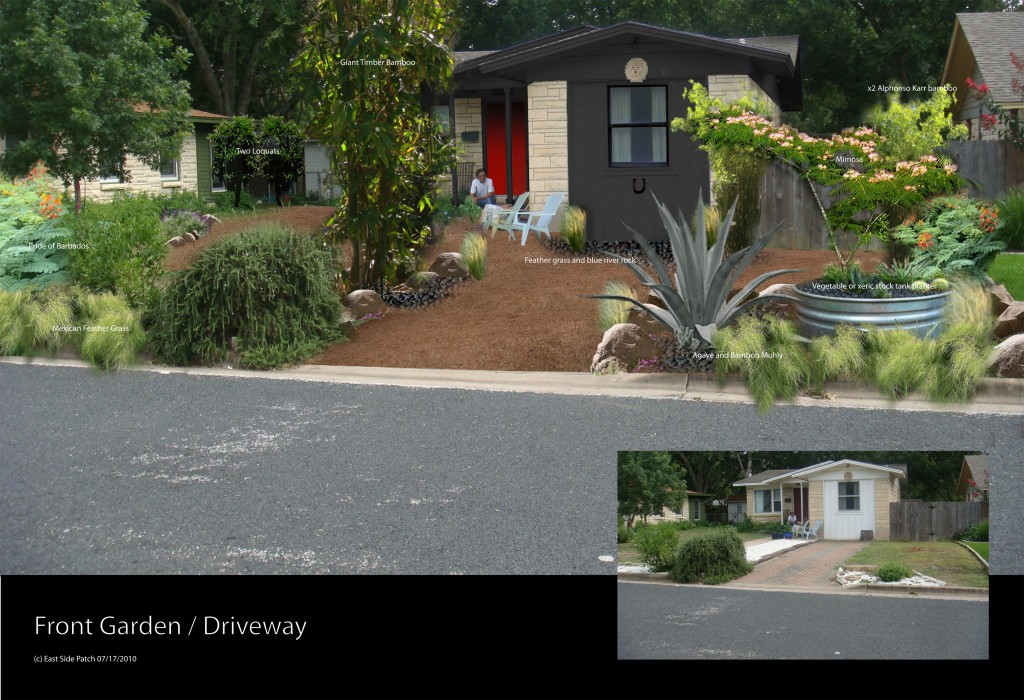
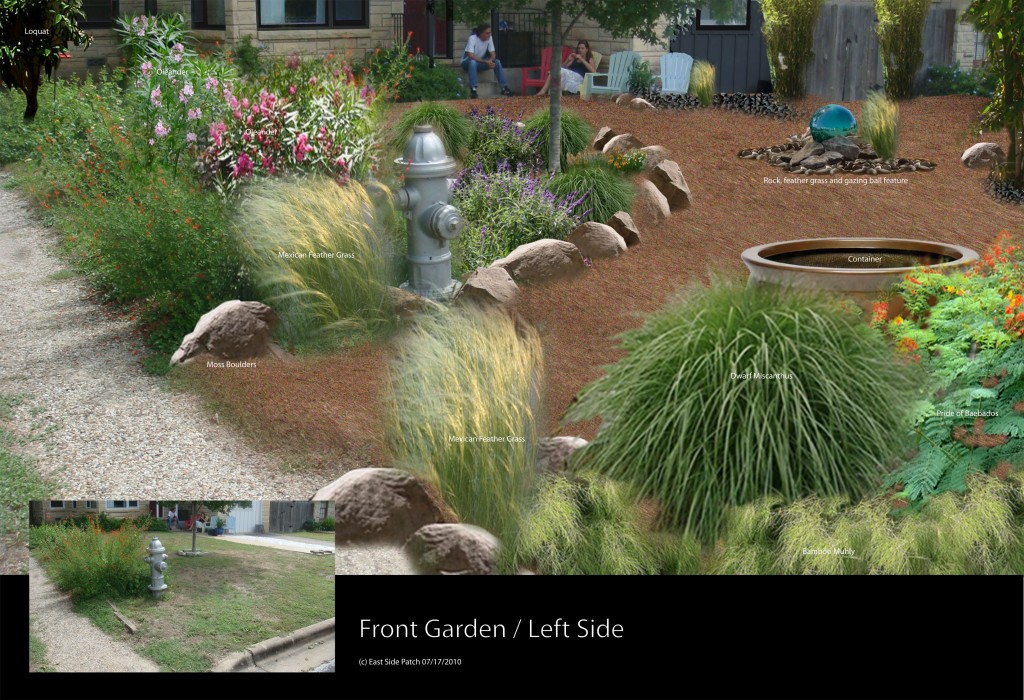
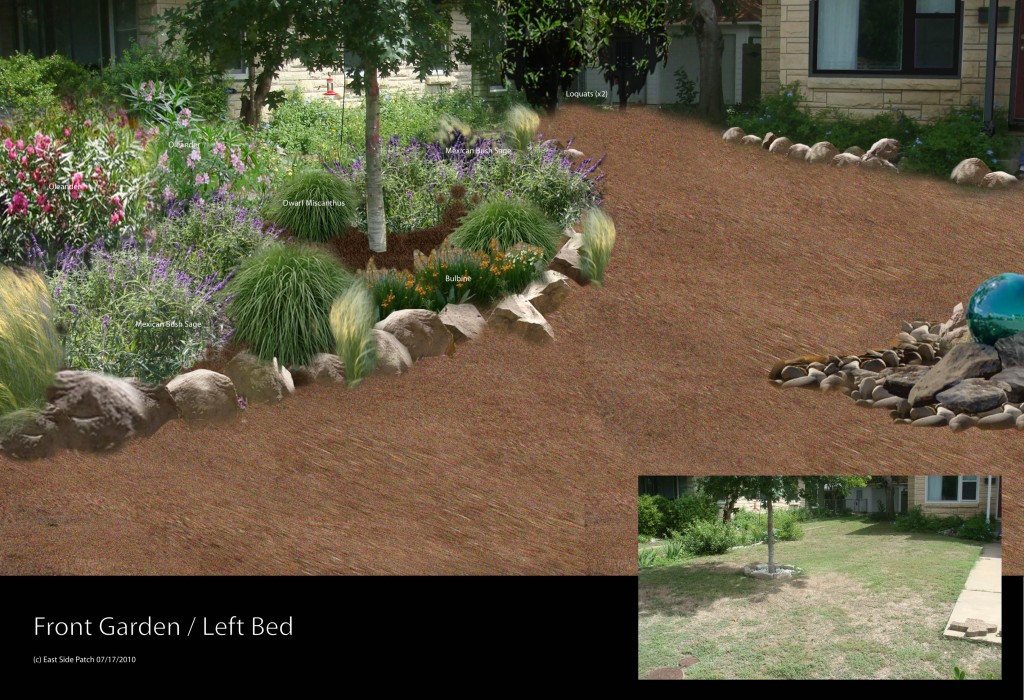
For the front of the house I decided to open up the doorway area by removing the existing, rather claustrophobic bed. I also introduced an additional sweeping pathway to the side of the house for alternative access to the rear jungle scene. The materials and tones are consistent with the new rear design, visually referencing the existing stone of the house. A new home color scheme punches out some curb appeal, creating a more contemporary, less Tudor aesthetic. What design would be complete without some mounding artemesia, an evergreen wisteria climbing over a simple arbor for some porch fragrance, and a few metal chickens?
Installation begins in a couple of weeks!
Back to the Patch…

…and some very eerie yellow light conditions.

Talking of very eerie things. Remember my disgusting rotten elephant ear that sprouted some side growth? Well, I was giving it a drink this morning when I happened to notice a rather dark hole where the bulb used to be that rotted. Thinking it was just the cavity left behind where it had rotted out I filled it with water from my hose. The strange thing was, the water never pooled up, it just kept immediately draining almost instantly? Odd I thought.

I put the camera in the cavity and took some pictures with the flash on, these shots do not do the tunnel justice…it was deeper then I could see. A Naboo mine shaft perhaps?
 Worm sign?
Moving quickly along…

The diagonal fibers on this soft leafed yucca were so perfect that it looked manufactured.

Is that a spider in there? Brrr.
Some plants just go and keep going through our hottest months:

Pride of Barbados…Okay, I promise this will be the last time I blog about it this year.

Evergreen wisteria still as fragrant as it was in June, though it has looked better.

Illuminated by a setting sun, purple fountain grasses offer great late summer / fall color and movement. I treat this grass as an annual and generally use it as a gap filler in the patch, it really works well with purple heart, and set against a shady backdrop it takes on a life of its own.


Finally…

Happy birthday, birthday boy!
“To infinity and Beyond.”
Did you recognize the time / space defying tee-shirt, the one that keeps showing up throughout Earth’s history?
Stay Tuned for:
“Spitting Seeds”
All material © 2010 for eastsidepatch. Unauthorized
intergalactic reproduction strictly prohibited, and
punishable by late (and extremely unpleasant)
14th century planet Earth techniques.