 “Look at that probosces…yeah baby, yeah”!

Sphingids are a family of moths, commonly known as hawk moths, sphinx moths and hornworms. They have been much studied for their flying ability, especially their ability to move rapidly from side to side while hovering, called ‘swing-hovering.’

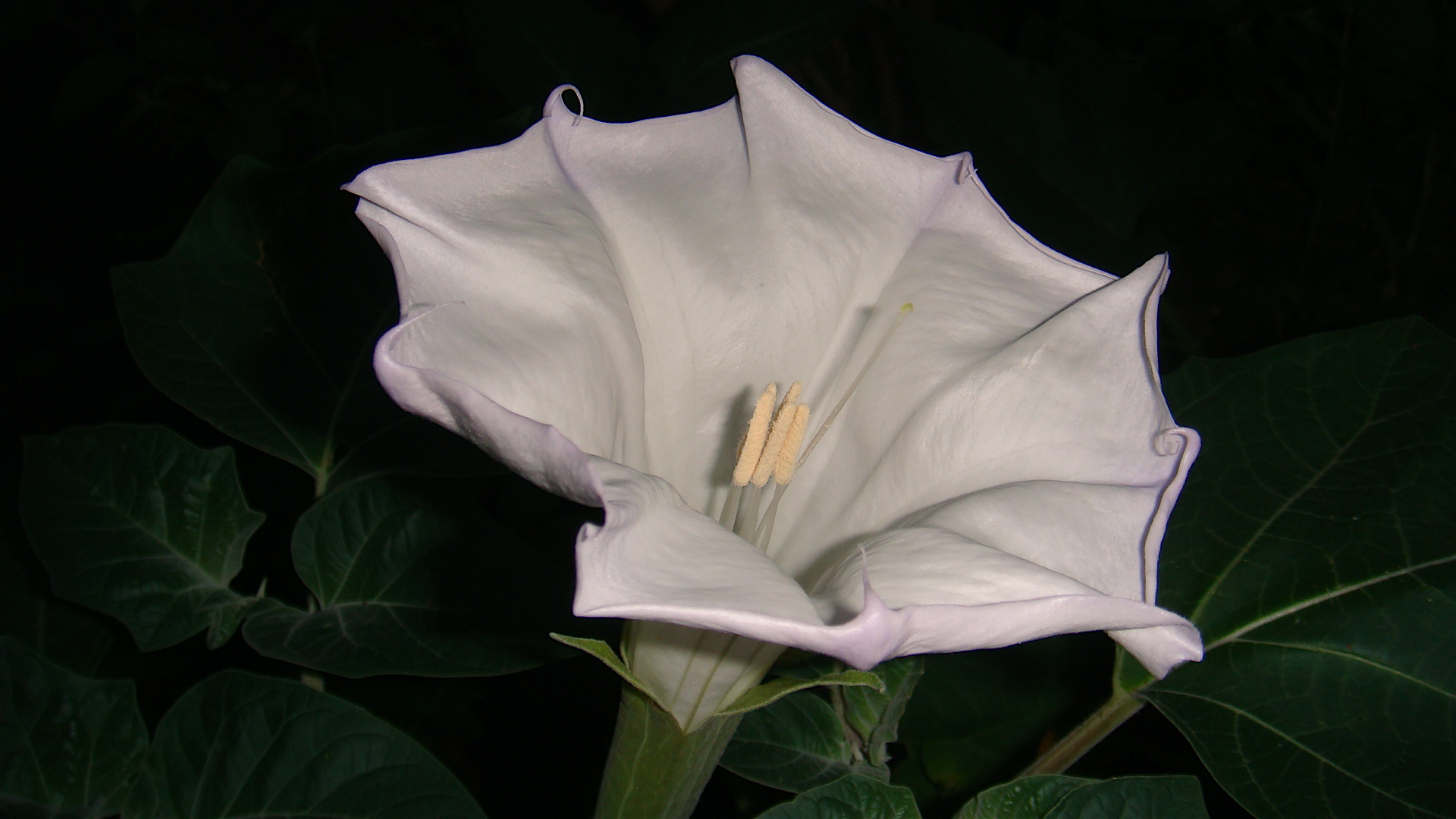
It is thought that this evolved to deal with ambush predators that lie in wait in flowers. This bird loves the luminous night blossoms of the Sacred Datura plant, also called “jimsonweed” or “devil’s weed”, the blooms of this plant last only for one summer night and as such must work fast to attract pollinators, and what pollinators it attracts!
 The large Manduca sphinx moths are not only essential pollinators of the night-blooming datura plant, but the plant’s surplus foliage supports the developing larvae of these sphingids. It’s called mutualism. The larva develops over twenty days and then molts to the pupa stage. The larva then drops to the ground and burrows into the soil where it constructs a pupal cell immediately before pupating.

The adult moths feed on nectar, this one was in a complete frenzy, it smacked into me twice while ‘swing-hovering’, before it audibly “ka-flumped” as it belly-flopped into this bloom. The body of this moth is about the size of a mouse (with a wingspan brrr) and I have to say it was quite disconcerting as it drunkenly careened into me at full velocity, pausing only for some freaky under-chin fluttering nonsense, every time the camera flash went off.
 Needless to say, I only got these two shots in before wildly slapping myself around the neck area and running blindly (the flash had semi blinded me) for the safety of my house. I could hear “fluttering” immediately behind me as I stumbled.
I went out this evening, intending to stay out, to conduct some, temperate midnight mulching (as you do). As the light disappeared in the Patch, I switched on the lamp strapped to my forehead and entered a quiet and relaxed state of maniacal mulching. Mulching is great, it is not loud – no fear of waking the kids or the neighbors like a bobcat has a tendency to do, and applying it offers an instant visual gratification whilst smothering the weeds. At least it does if performed in the daytime…
…the added benefit of midnight mulching is the next morning, when you wake up and get to see your work in its entirety.
Now to the haircuts…
 I could stand it no longer, the dreadlocks, the matted island hair, these mounds of straw had to be taken care of immediately…it was time for crew-cuts all round for my Mexican feather grasses.
 I could hear them all moaning and complaining as I walked down the pathway to my shed to retrieve my shearing implements and the bib that I will position around each one’s shoulders as I move among them. Now is a good time to trim these grasses a little as a) if you are like me, you are probably completely fed up looking at their teenage mops and b) by cutting them back in August, it allows the plant time to recover and grow back for good winter form.

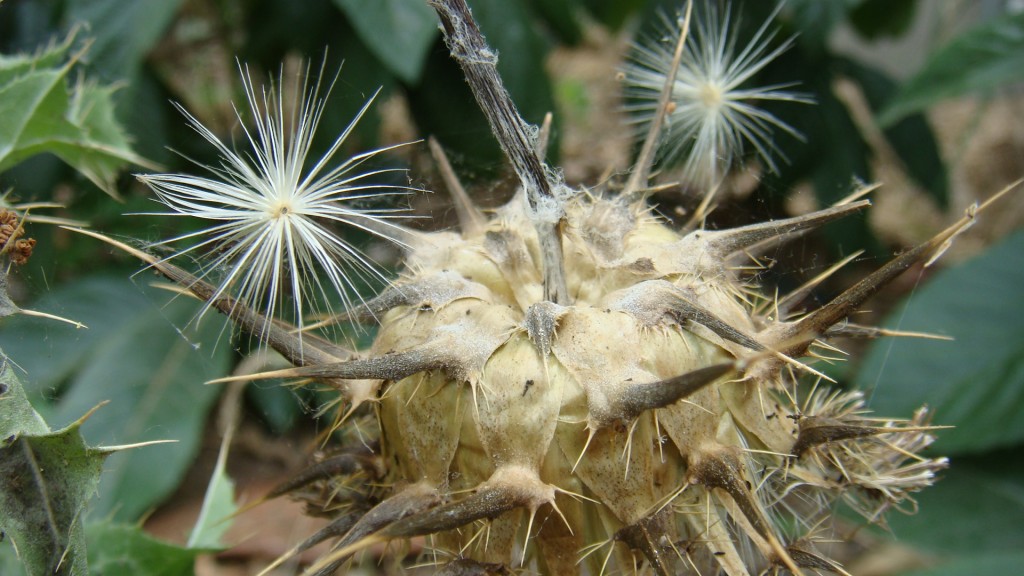
Ahhh, so much better, I can see their faces again…I must stop brushing up against that Jimsonweed!
You know it is hot when even the amaranth starts to wilt (right).
There was one lucky girl that did escape the barbers wrath…
 That was because her hair was adorned with these lacewing jewels, that I just happened to see at the very last minute. Stalked eggs are typical of lacewings. The larvae are so hungry and ferocious, that if the eggs were grouped the first one to hatch would end up devouring its siblings.

I take it your siblings did not have the luxury of stalks FB?
 Here are some more hanging from one of my sotols. The theory is that the stalks ensure a higher birth and survival rate, due to the fact that the larvae have to climb down the stalks.

“Facinating ESP”. Zzzz
While I was on my back with my face buried under foliage trying to capture a shot of these minuscule eggs I glanced over and saw this monster looming above me, in fact I only had to shuffle over a few inches to take this shot.

Ahhhh!
Cicada shells are almost as bizarre as the actual insect. Pam over there at Digging recently took a great picture of a cicada, riding it’s trusty steed: http://www.penick.net/digging/?p=8861 I am just glad this one did not decide to dismount as I took this shot, oh yes, I would have been sent running wildly into my house, clawing once again at my neck region…I wonder what my neighbors must think?
Moving on…

Purple heart has responded to our Texas august heat by saturating to even deeper shades of purple.


The foliage on my Madame Ganna Walska tropical waterlily is as interesting as the blooms and like the purple hearts, they are also very saturated at this time of the year.

I found this old tomatillo lantern on the floor underneath the mother plant…

…a plant that is threatening to take over an entire corner of the Patch.

Although quite beautiful, this is now the surface film of the sinking mosquito dunk (I featured a few posts back) that has developed in my “everything but the kitchen sink” rainwater collection “system”. I am not surprised this will kill mosquito larva, but really! I am now fearful of even using this water on my plants, even though the packaging stipulates it is completely safe.
Finally:
After I removed the mesh from my tomato plants a couple of months ago, I rolled it up tightly and stuffed it underneath my shed. Today, walking up to get my shovel to plant a new oleander, I noticed that a corner of it was poking out.
I investigated further and found this:

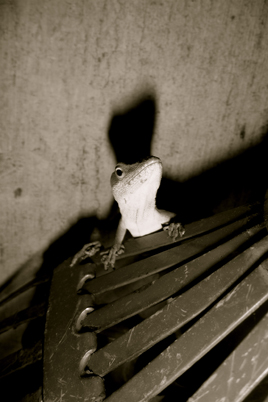
A Texas spiny lizard.
Sceloporus olivaceus
This poor chap had himself completely entangled. The above picture was taken after about ten minutes of careful snipping with some scissors. The hobbits were very excited to see one of these up close, considering how fast and shy these creatures typically are. The worst part of the snipping I saved till last, the neck and head, he kept attacking the ends of the snippers. A few final tighter snips and he was free, I cannot tell you how fast that creature took off!
I took the mesh immediately indoors.

I will leave you with this…the Gene Simmons of the butterfly world.
 Stay Tuned (once again) for:
“Wilson”
All material © 2010 for eastsidepatch. Unauthorized
intergalactic reproduction strictly prohibited, and
punishable by late (and extremely unpleasant)
14th century planet Earth techniques.