Every garden design presents its own unique set of challenges, both physically, spatially, aesthetically, emotionally and of course financially.
The designers role is to synthesize emotions, set expectations and ultimately deliver the most creative, appropriate and optimized design scheme within the scope of the project to the best of his or her abilities, and then successfully execute it.


This design process sounds quite straightforward, but in reality, it remains very organic in nature, planned…yes, but organic, as it should be. The most ‘developed’ design, as pretty as it may appear on paper or LCD, mutates as you grit teeth, grab an iced turban (if it is summer), long johns (in winter), and start working into it, armed with a shovel, a strong will,…
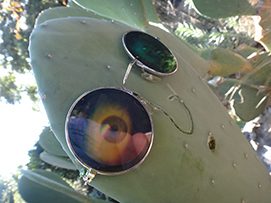
 …and an ever roaming, critical eye. I always adorn the toy version of Mad Eye Moodie’s roaming eye on initial site consultations, as I survey the area making notes. Most people interestingly choose to ignore it.
 This garden had attempted to make some sense of splitting up the space, it just struggled with the fundamental questions: why? And for what exactly? The homeowner communicated early on that he wanted a low maintenance, low water needs solution and that he wanted to eliminate his mostly dead and weedy grass…sweet music to my ears.
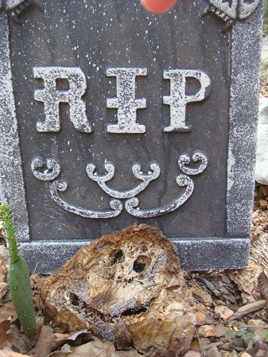
 RIP Zelda
The first port of call in this scheme was an exorcism to purge the space of all preexisting metal and rubber edging (you all know what I think of this) to
(a) stop me tripping over it as I moved through the property and
(b) well, it just makes me feel better.
 The plan that I settled on integrates and plays off the existing oak tree, drawing visual attention away from the expansive rectilinear perimeter, focusing it to a formalized, and centrally concentrated planting scheme. Why? Well this has the effect of visually shrinking the space (and cost) associated with heavily planting up the perimeter (not an option in this case). A simple and sparse planting of loquats and a couple of large corner miscanthus will visually and quietly soften up the perimeter, pulling in the focus to the centralized and more densely planted, arching salvia leucantha and rosemary planting beds. These curved beds enclose the space and create a more intimate environment, helping to direct the eye to the end focal point…two smallish crepe myrtles (different colors) . These myrtles are guarded on both sides with my favorite evergreen, yes, you guessed it, Arizona ‘blue ice’ cypress.
 These cypress trees will ultimately end up like nightclub bouncers, bodyguards protecting the star.


Here is a rendering (left) on top of digital photography that was used to convey the scheme looking back toward the house and here is the reality of the design (right) in the midst of implementation, (the bricks have not been bedded yet). With all the metal edging taken up, and a new, more organic flow through the property introduced, the space already feels more natural. The beds will be planted up when the weather is not quite so restless.
 Oh give it a rest Jack.
Staying with the weather a moment, I took a walk down to my large stock tank to check on my fish early this morning.
 It was a little more extreme out there then I had anticipated.
We are currently hunkered down inside the Patch with an Arctic front whistling through our long-leaf pine walls, and the oven open and set to 350! It is quite possible we were the cause of the rolling Austin blackouts. The good news is that my halflings got to witness this week just how brilliant hot water bottles actually are when Texas temperatures dip…one of Britain’s best exports.

…Precisely.

A thin layer of ice had formed,

encapsulating this water lily that actually bloomed only last week.
 This lone, motionless goldfish looked like the waters had frozen around it.

 Moving quickly indoors…remember that hair sap?
Lucky for him his mother is a hairdresser who just said “oh, lets just cut that out”!
His reward for this test of endurance?
 “Cargo bay doors are open Captain…


excepting delivery…
 Cargo bay lock re-engaged sir”.
A dinner at his favorite ‘sarcophagus’ restaurant. Oh yes, you are in for a real treat if you get a table anywhere around us! Your fine dining experience may indeed be compromised.
Finally:
I will leave you with a little freezing damage already visible.

My last tiger aloe has turned dark purple, never a good sign,

and my Mexican lime tree is once again looking decidedly ill, I feel another mammoth leaf drop is around the corner.

Cold little hands and fingers have been exploring and prodding their way around this new icy world.

And then this morning?

A Texas winter wonderland!

No school today.

This cannot be a good environment for “tropical” water lilies!
Stay Tuned for:
“Ice Ice Baby”
All material © 2011 for eastsidepatch. Unauthorized
intergalactic reproduction strictly prohibited, and punishable by late (and extremely unpleasant) 14th century planet Earth techniques.
 Check out this “Rangers” site: http://www.wildliferanger.co.uk/