Insects

“Blast from the Past”

I found some old photographs while I was in Scotland…and took pictures of them.

This is me, on one of the many occasions my sister took advantage of the fact that I did not really mind being taken advantage of.

DSC02407

Note: Mud-pie bucket…fantastic!

DSC02333

Sweet big sis…mostly ;-)

DSC02392

DSC02404

My sister had an affinity for training animals at a young age.

This was our first dog, “Amber”.

DSC02389

My dog encounters unfortunately involved receiving a lot of puncture wounds.

Amber apparently did not care too much for having her juicy bones removed involuntarily from her jaws by a small child uttering complete gibberish.

I cannot blame her.

trip_to_beach

I had to include this photo with my cousins just because it communicates the “tolerance and general demeanor” of the average British seaside excursion…(character-building stuff a trip to the seaside : no iPhones /iPads back then).

Ah yes, I remember the days as if yesterday…freezing-cold North Sea water, crunchy sand-filled sandwiches, windbreaks, flasks of tea, and the ever-present sensation of always being just a little “too cold”, even on the hottest days of summer,

DSC02350

a sensation I cannot say I have ever had in our Texas summers…

the_mummy

…”Only one more planting-bed to go honey”.

DSC02364DSC02398

I think I must have been auditioning for a part in The Nutcracker in this one.

Note: Background windbreak.

DSC02328

Moving Less Nostalgically Along:

Back in the Patch:

IMG_0457

More rain storms this week…and it is almost August!

bolt

This storm front arrived packing a serious light show, thank goodness this bolt missed my post oak on the left.

DSC02772

The barometer sages

Leucophyllum frutescens


had correctly predicted the weather change once again. It is said that heavy pruning can diminish the blooms on these plants, but I have never noticed any degradation and I keep these two pruned tightly to reduce legginess and central splaying.

Texas_sage

These two will be getting an aggressive haircut as soon as they finish showing off,

DSC02768

and the plants are not completely covered in bees and hoverflies.

DSC02736

Other observations this week:

dragonfly

Blue Dashers and many other dragonflies are busy posturing and performing some quite “risky” meter high antics.

Dragonfly DSC02670

The waxy Moy Grande (Texas Star Hibiscus) has thrown out some massive blooms this week.

DSC02669

On a contrasting note:

Remember these fine “cowboy toilet paper,” mullein?

DSC011911 images

Well they are not so fine any more.

dead

If this is what happens to them in the summer it must have been an inconvenient and a rough

(and I do mean “rough” ahem)

few months for the cowboy on a strict bean diet.

213-cowboy_stance

Enough said.

Now onto some critters:

DSC02730

Stepping into this sandal would have also been an uncomfortable experience.

This is a great leopard moth caterpillar and it cast a long shadow as it quickly crossed our carpet the other night.

DSC02726

It was huge.

Some friends of ours found this rhinoceros beetle,

Dynastinae


IMG_1930

They are also called elephant beetles, Hercules beetles, or Atlas beetles some of which are among the largest beetles on Earth.

This one is a male as it is sporting the “tusk” which is used for fighting both over females and for feeding sites and rites on trees, logs, and crops.

In spite of their fierce appearance, these beetles are harmless and feed only upon plant material.

Finally:

Laziness, procrastination, heat and an unwillingness to wield my pick axe resulted in a great result this week.

DSC02585-1024x576

After my strange yucca tumbling and sawing of the trunk at the base, it was my intention to dig out the tap root and replace the plant with something else. I even tried a shovel on it a few times but it wasn’t moving, so in the ground it stayed.

DSC02759

After the rain I walked past the stump and yes there it was, not one, not two but numerous new yuccas on the rise.

…In fact, a scary amount.

DSC046071

I am looking forward to seeing what will happen here.

Stay Tuned for:

“Design Up-Front”


All material © 2013 for eastsidepatch. Unauthorized
intergalactic reproduction strictly prohibited, and
punishable by late (and extremely unpleasant)
14th century planet Earth techniques.


Scotland

This is a very normal expression for me after completing a transatlantic crossing.

In fact, I usually stay like this for a further three days until the memory of the journey finally works it’s way through my subconscious and I can get back on with my life again.

32000_feet

The 50 year old plane with old fashioned CRT TV’s placed at strategically uncomfortable viewing angles, the cramped conditions, the never ending servings of food groups that have no right to be served at 32,000 feet,

Chicago-style deep pan pizza!

…Really?

The whole flying experience leaves a lot to be desired…everything in fact.

To relieve the monotony a welcome leg-stretching venture with my son to the aircraft’s ‘restroom’ was met, as if on cue with the “bing” of the “fasten your seat belts” sign and just enough turbulence to ensure that a wild urine dodging line-dance was randomly choreographed to the little known Johnny Cash tune “Just keep it aimed down there son, just keep it aimed down there”.

BGT_JUDGES_01.JPG

It was a ridiculous jostling performance in the already confined space but one I thought worthy of a place on ‘Britain’s Got Talent’ for limiting collateral damage.

The psychological distress of the journey to Scotland apparently appears to be hereditary.

Manchester

Hours later and we arrived in Manchester airport and quickly headed north in our taxi.

387402_mel-gibson-jako-statecne-srdce_image_620x349 Scotland

We flew past countless wind turbines looming over the hillsides with an eerie “War of the Worlds” stature.

Scotland

The closer we got to our destination the smaller the roads and higher the hedgerows became.

We rounded a corner and were relieved to have finally arrived at our holiday cottage in Powfoot on the Solway Firth in SW Scotland.

Dumfriesshire

This was the remarkable view looking out from our front window.

She wasted no time with her collection habits now in overdrive.

Solway

A few shells here, some weathered glass there, she had an impressive collection labeled and segregated in no time at all.

beach_combing DSC01809

The salt marsh coastline was blanketed in the blooms of sea thrift which is one of Britain’s most prolific coastal plants. Thrift belongs to the sea-lavender family (Plumbaginaceae) and it is quite talented at surviving very harsh and salty conditions.

merse

Salt marsh is found where the sea floods low lying land. The land is drained by channels eroded in the mud and flushed by the tidal waters. At this stage the saltmarsh can be used as pasture and in the Solway it is known as a merse. Many of the flowers found on the merse have leaf adaptations which help to reduce the loss of fresh water by evaporation. This carpet of grassy merse attracts geese and swans as well as other wildfowl over the winter months.

High-Tide Birds

The Solway coast is also one of the most important places for migrating waterfowl on the eastern Atlantic seaboard. On a rather brisk (to say the least) walk up the coastline I disturbed this large flock of oystercatchers,

eggs

and found some of their eggs on the shoreline, naturally these went into the “collection”.

I found another ‘oyster’ on the side of a local tree,

this time in the form of an oyster mushroom,

Pleurotus ostreatus


toadstool

I also came across this Birch Polypore,

Piptoporus betulinus


also known as Razor-strop fungus as the velvety surface of the fungus was traditionally used as a strop for finishing the finest of edges on cut-throat razors.

Moving Along:

Further inland I took my children deep into the forests where I spent the best part of my childhood.

woods

some of the trails were still worn,

though most had been reclaimed by the passage of time and lots and lots of ferns and foliage.

DSC02429

We could have easily lost the little folk in here.

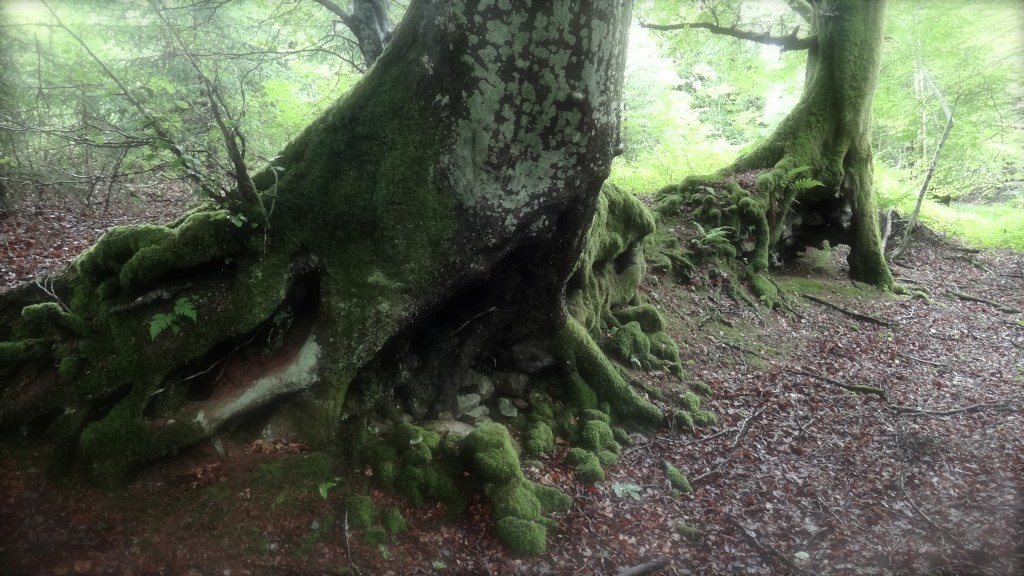
roots

The heart of the forest is a magical place,

populated by towering Ents gripping the forest floor,

and shy sphagnum moss sprites

that dance lightly on the hummocky mounds.

DSC02421

These mossy areas will quickly fill up an unacquainted visitor’s boots as the surface covering of mosses can be very thin, hiding a treacherous ooze below.

A few more twists and turns and I found what I was looking for,

graveyard

Kirkconnel church and graveyard.

Having a propensity for all things Gothic this secluded and melancholic place sparked my imagination as a child as it still does today.

Shrouded by the forest, remote and completely overgrown, the angled gravestones are straight out of a Harry Potter scene.

DSC02445 copy

The history of this little churchyard with its ruined medieval church and its Latin cross is clouded by myth and the absence of documentary records during the troubled centuries between the departure of the Romans in the fourth century and the peace that followed.
Kirkconnel church first comes on record in 1191.

church

The gravestones in the churchyard are in the tradition of the days when reading and writing was virtually unknown.

Kirkconnel-church

Many simply show skull and bones whilst others show a carved hour glass indicating that for someone the sands of time now stand still.

Kirkconnel-church

After a brief pause for some corned beef sandwiches and ploughman’s pickle we left the little graveyard behind and continued through the forest.

Rhododendron ponticum

We walked past a lot of these invasive wild rhododendrons

Rhododendron ponticum


that were peaking during our stay.

flowers

Root suckering, together with its abundant seed production has put this shrub on the invasive list.

roots

“Rhodie-bashing” or Rhododendron control, is a key element in nature conservation in the worst infected areas where it is crowding out the native flora.

Here is another one weaving its way through the lower canopy of a Laburnum,

the hanging yellow flowers on the tree are responsible for the old poetic name ‘golden chain tree’,

Laburnum Arch, Bodnant Garden, Gwynedd, Wales

when trained it can provide some very dramatic effects.

Running alongside the woods were meadows full of wild flowers.

wild-flowers

Dog daisies,

wild-flowers

dandelions, a few Scottish thistles, and lots and lots of

meadow

spit!

spit

These frothy areas on foliage are a protection for the froghopper nymph.

Carefully remove the bubbles and you can find him.

uncovered

“I’m all exposed, I’m all exposed!”

And here is what it matures into:

Philaenus_spumarius

The common meadow froghopper,

Philaenus spumarius


It has recently been discovered that this froghopper is a world class jumper (up to 70 cm into the air) beating the the flea. What makes this even more impressive is that the froghopper is much much heavier. The back legs are so well-developed that the initial stages of the jump a G-force of over 400 gravities is generated.

Along with the spit there were the slugs,

but I cannot bring myself to write about those.

harry_potter_and_the_chamber_of_secrets DSC02435

On exiting the forest we passed some very impressive copper beach trees,

making-friends

and were met by a herd of inquisitive cows who enjoyed licking the chip-salt from our lunch fingers.

DSC01902

Back in civilization the fragrance on this roadside clematis

DSC01994

filled up the surrounding area.

smelling

We walked past dry stone walls that are a common feature in the area.

Many of them had pockets of small succulents emerging from between the stones.

succulents succulents

Finally:

cottages

All this rambling around the countryside had generated quite a thirst so before retuning to our cottage we dropped into the only watering hole for miles around…

…for some of the best ‘Best’,

…and a basket of

Scampi_and_Chips

Then it was back to the cottage to play our latest obsession:

boardgame

Stay Tuned for:

“Journey to the Highlands”


All material © 2013 for eastsidepatch. Unauthorized
intergalactic reproduction strictly prohibited, and
punishable by late (and extremely unpleasant)
14th century planet Earth techniques.


1 2 15 16 17 18 19 74 75