Say Ahhh! Or Ooo…

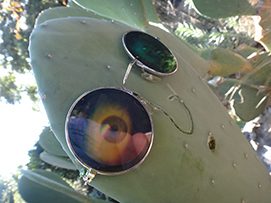
The blended rainbow colors forming on this dying giant timber bamboo culm are quite psychedelic at the moment…very Aurora Borealis. And just why am I staring meditatively at bamboo culms, performing deep breathing exercises?…Let me back up a little.
 I have had a long and turbulent history with my two eldest barrel cactus. I had them in pots for the longest time as I prepped a fast draining bed in the Patch. The exciting day finally came, the bed was ready and so was I. I carefully extracted them from their pots, wrapped them in a very “ET” fashion in blankets and took full advantage of their exposure to tease out the Bermuda grass that had annoyed me for years. This grass embeds itself (as only Bermuda grass has a propensity to do), in the most inaccessible places known to man, in this case, tight in tight against the body of the barrel, behind the geometric spines…it was the perfect impenetrable fortress.
 I spent time easing this grass out of the root ball with some rudimentary medical implements, and oohh was it satisfying. I looked like an unhygienic surgeon (complete with dirty fingernails), hunched over my “temporary operating platform” (my wheelbarrow), occasionally throwing my head back to manically laugh out loud as each individual blade lost its annoying stronghold on the root ball.

After relocating the barrels into their new home I was feeling pretty good, at least I was for a couple of months…then the unimaginable happened. I walked outside one morning to find more blades of Bermuda grass once again growing up from their bases, after all of my surgical diligence!
 I had once again failed to eradicate my terminal enemy.
 After all of our recent rains of late, I thought I would try one final desperate strategy…pliers! Why had I not thought of this before? I must say it worked very well with our softened soil, even though with each grass extraction, the back of my hand kept painfully impaling itself on adjacent smaller barrels as the Bermuda grass root would give way, though it was well worth the pain.
I have told you how much I HATE Bermuda grass at some point, right?!
There is only one thing I can think of that is worse, and perhaps more annoying and painful…

 Naturally I am referring to the extraction of pampas grass. This particular pampas has been flogging flesh from my arms for a couple of days now, up to its extraction, and actually for some time after. Yes, that is my wheelbarrow handles poking out from under all of its hair, hair that insisted on wrapping itself around my exposed legs as I tried to push it. I know I know, I should have worn long pants, but it has been so incredibly humid! I had to take my chances.
I obtained a few lacerations prior to the extraction trying to get a good shot of this shy grasshopper who proceeded to shuffle round to the other side of the grass every time the lens approached it.
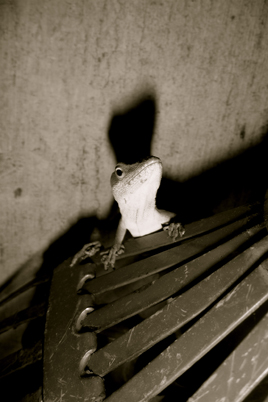
 I played his game for some minutes before eventually giving up, all the while feeling the intent stare of…
 “I wouldn’t dig around that grass if I were you, oh he’s started digging!”
…this nosy little anole. Very “human” eyes.
I struggled and punched (with gloves on naturally) the razor wig into submission in a trash can and dragged it out to the curb. With a final strand unknowingly encompassing my arm I walked away.

Inhale slowly through the mouth…hold….and exhale.
Moving On:

After the recent discovery of a rather large hole in the side of my camper, I decided to just take the whole thing off completely. This proved a little more taxing then I initially anticipated, mainly due to the weight. This could have easily been another Darwin Award, like the hanging of my wind chimes:
http://www.eastsidepatch.com/2008/05/wind-chimes-and-my-post-oak-a-darwin-award-nominee/
but once again I got away without one.

Where she fell is where she lays, vividly reflecting my Celosia plants and my vitex in the front of the Patch, a very odd looking sight. I do like granite but not enough to bury my entire truck!
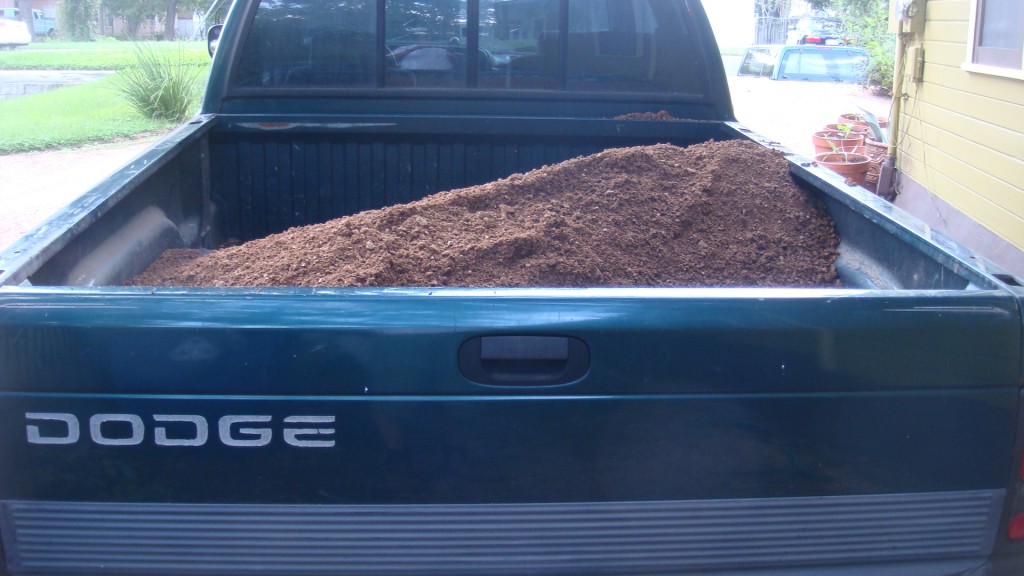
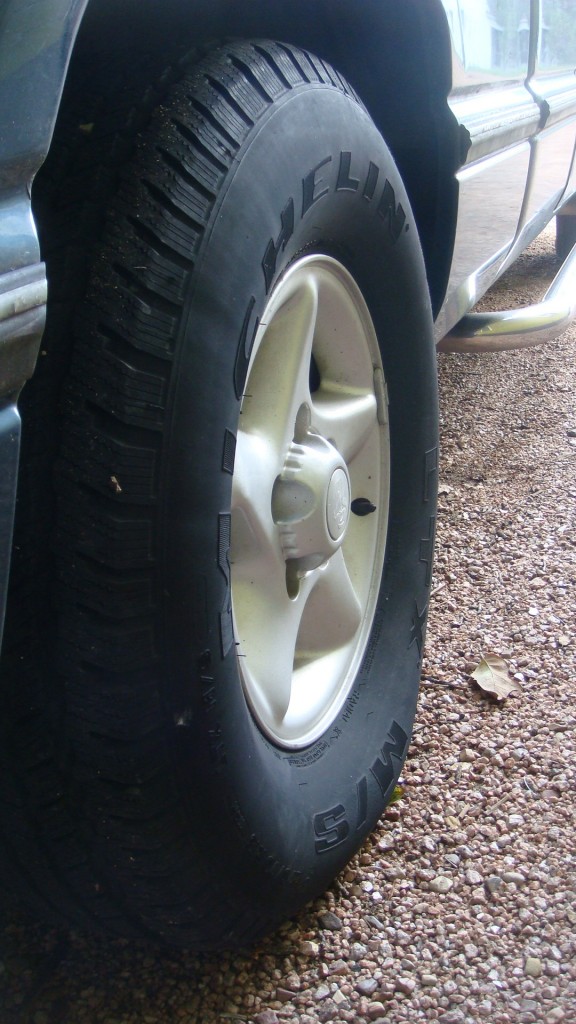
The good news is that once again I can get a scoop of the good stuff dropped directly into the back bed…I have missed this!
No sooner the camper was off, I was off to see if my old steed could still haul some of the brown gold. Some transmission slippage later, I was back in the Patch to touch up some of my pathways that had degraded over time, compounded by the erosion of the recent rains that have been transforming my walkways into small fast-flowing rivers on a regular basis.

And what a difference it made. What was once dirty looking granite is now looking like a new carpet that has had a Dyson running over it for 24 hours. I had no idea how bad it had looked until I laid out this new top layer.

It even has lines on it like a new rug.

This digger driver took immediate advantage of these new soft piles of granite, it kept him quiet for ages.
The other good thing about not having my camper on…

…you can sit on the tailgate and eat popsicles, oh and haul some serious cedar carcasses, courtesy of my friend Bob over there at Draco: http://dracogardens.blogspot.com/
Thanks so much for these Bob, they fit right in.


I like to use these twisted tree limbs to elevate Mexican gazing balls, which usually tend to get visually lost if just placed on the ground. They offer a great otherworldly, storybook aesthetic…you cannot beat that.

Within minutes of this ancient looking stump being positioned, this spiny Texas lizard was all over it!
Talking of ancient:
 Fossils of this plant have been found on almost every continent on the planet. Cycads are often referred to as “living fossils”. And just how have Cycads been so successful? Well for a start, they are totally lethal! I had no idea.
The incidence of Sago Palm ingestion by pets has risen by over 200% in the last five years, due to the plants current popularity. Sagos apparently taste like Oreos to cats and dogs, a staggering 50 to 75 percent of cases involving ingestion of Sago Palm result in fatalities. This is remarkable considering how sharp they are, I had two blood spots on my knuckles just taking this shot! I would have never considered this plant poisonous, it just looks so benign, but all parts of this plant are toxic, particularly the seeds.
Talking of seeds:

I cut back my cone flowers aggressively a couple of months ago, and they have responded with new flowers.
In a similar hue, “whirling Butterflies” or Gaura are putting on their own dancing flower show right now.
 As is my Barbados cherry, that was all but dead at the start of this year.

And behind it is…
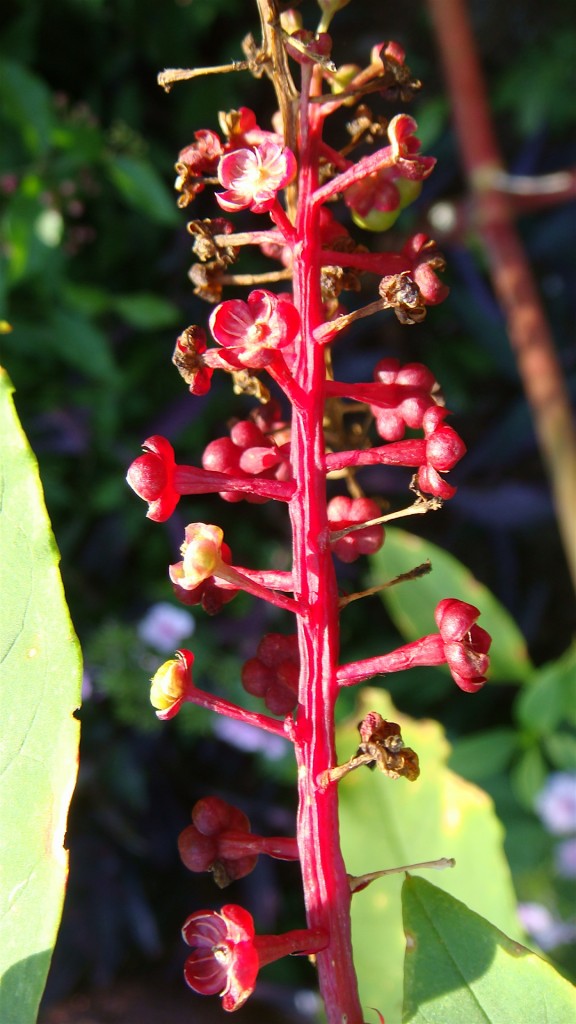
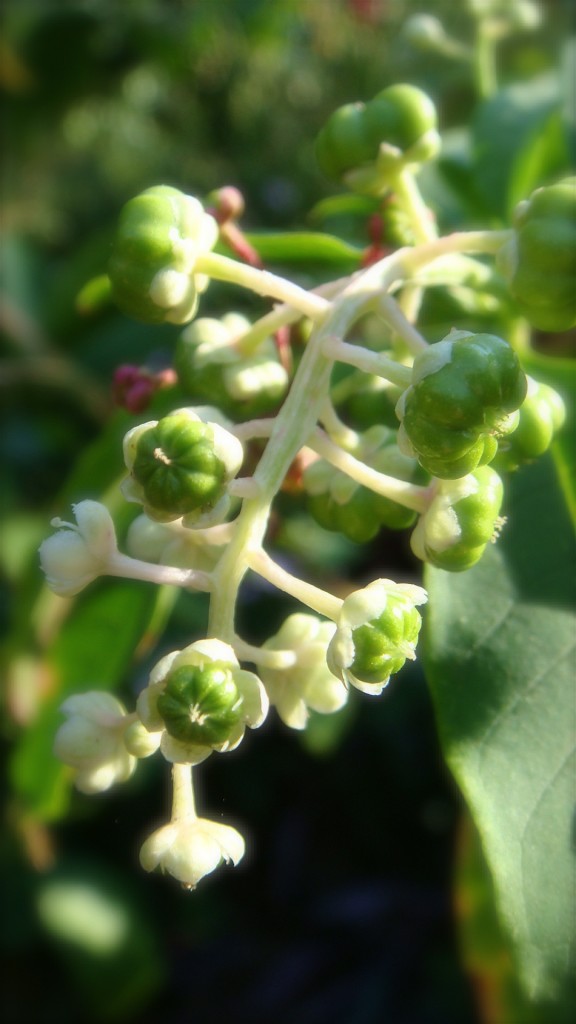
my pokeweed. This plant is putting out a second set of berries right now, and to think that I was about to pull this plant out of the ground once again! This plant has been full of surprises since I first noticed it. Amazing how the stems turn from white to red as they mature.

The regular rains and cooler temperatures have really perked up these small sedums.
 Even the gopher plants seem happier then usual.

And artemesia fills in the gaps. I have tried to time this plant so
a) it wouldn’t be too leggy and
b) it wouldn’t be too sparse for the upcoming Garden Conservancy Tour on the 16 Oct. http://gardenconservancy.org/opendays/events.pl?ID=393&SortBy=&State=

Mark your calendars, and I hope to see you in the Patch.
Stay Tuned for:
“Event Horizon”
 All material © 2010 for eastsidepatch. Unauthorized
intergalactic reproduction strictly prohibited, and punishable by late (and extremely unpleasant) 14th century planet Earth techniques.