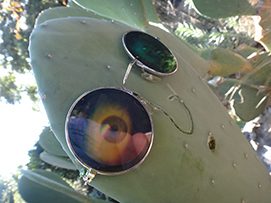
The flaps are up, the landing gear is down, please return to your seats and fasten your seat belts, we are on our final approach to the you know what, you know when. I am now in a constant battle with this pilot, as fast as I clean an area up for the http://gardenconservancy.org/opendays/, this maverick is tearing it up and scraping it down.
 As fast as he keeps landing his highly efficient plastic airplane, creating deep gauges in my granite pathways, I am there covering them back up with some frantic boot scraping and very dark muttering. It is as though he senses that the conservancy tour is looming ever closer and has upped his destructive tendencies accordingly…of course, I may just be a little more sensitive then usual in these “final days”!
 “It’s the Yellow Bells ‘Esperanza’!...they are late again!!!”

I have no idea why mine seem to bloom so late in the year, but they do.

This stressed out shield bug cringes deep inside this yellow bell every time the plastic jet careens around the decomposed granite pathway in its immediate vicinity. His antenna says it all, is he biting his fingernails behind there?
 And after a fighter pilot’s day is finished, what better then a debriefing near a stock tank with a neighborhood cat (yes, we have a few)…this cat drinks deeply from my stock tank on a daily basis, it’s stare all the while unwavering on the fish swimming just out of claw’s reach.

Moving up even higher into the cosmos, my moon flowers at the entrance to the Patch are also in full flight at the moment.
 Resembling flattened datura blooms, and equally as large. I started this vine from a seed earlier this year, I thought the summer heat was going to fry it to a crisp, but it pulled through.
 Very elegant. The underside of this plant is as dramatic as the top…a moon and a star!
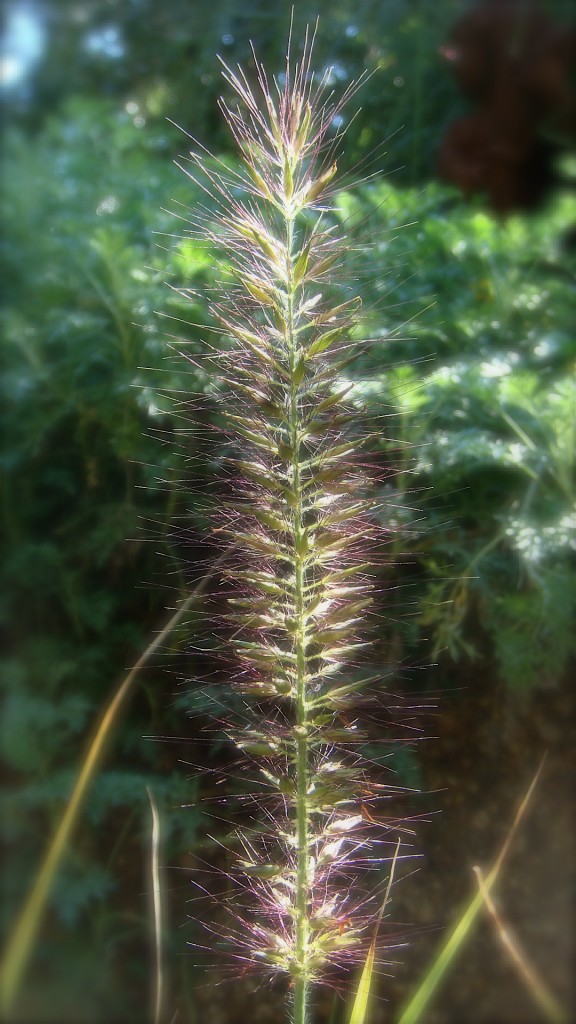
 From the waxy bold to the feather spikes on this black fountain grass:
Pennisetum alopecuroides ‘Moudry’
 Picture courtesy of De Groot, Inc.
Pennisetum translates as “feather bristle”, referring to the bristly structures surrounding the flowers on the inflorescence, in maturity it looks like water spraying from a fountain (hence its common name). This is my first year with this grass, I got a bit of a late start with it, but in the words of Captain Picard…“It has performed admirably”.
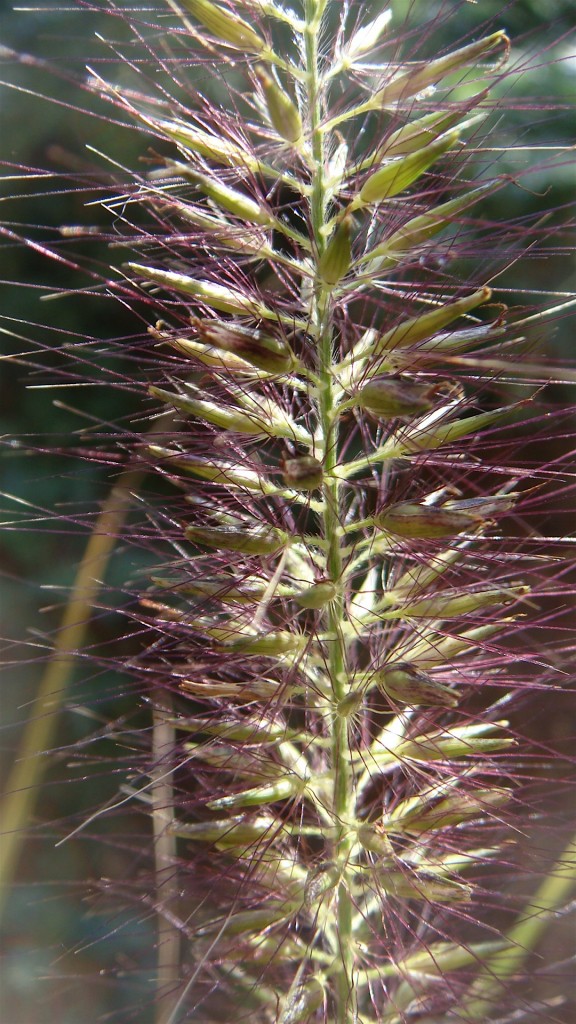
The plant has its origins in Japan and East Asia and it will readily self seed. I have read that it is better to cut the stems before flowers go to seed to control growth, naturally I will ignore this until it begins to be a problem. My palm grass was also a prolific self-seeder, I had quite a few for a few years and after last years freezes I now have none!
 “Seed yourself freely young Moudry”!
 Mexican bush sage and purple fountain grass orientating themselves at the sun. I like fountain, in fact I like all grasses, can you tell? The view from my front window (right) as I type this, really is quite something. Zzzz.

All manner of dwarf miscanthus are shooting out different shaped seed heads right now…great set against broad-leafed burgundy canna lilies.
Another rather unusual grass:

Chrysopogon zizanioides
or Vetiver Grass.
Vetiver’s roots grow downward (naturally) to an amazing 2-4 meters in depth. This makes vetiver an excellent stabilizing hedge for stream banks, terraces, and rice paddies, it is used for erosion control as this company in Hawaii demonstrates: http://vetiversystems.com/
 Anita Cooper’s water color of vetiver grass
I planted it precisely for this attribute on one of my mounds and it has worked out a treat.
 Vetiver is mainly cultivated for the fragrant essential oil distilled from its roots. Due to its excellent fixative properties, vetiver is used widely in perfumes. It is contained in a staggering 90% of all western perfumes (Lavania).
In perfumery, the older French spelling, vetyver, is often used.
 Another use for the grass is to make mats, these are constructed by weaving vetiver roots and binding them with ropes and cords, these are typically used in India to cool rooms in a house during the summer months. The mats are typically hung in a doorway and kept moist by spraying with water periodically, this cools the passing air and emits a refreshing aroma.
Moving on:
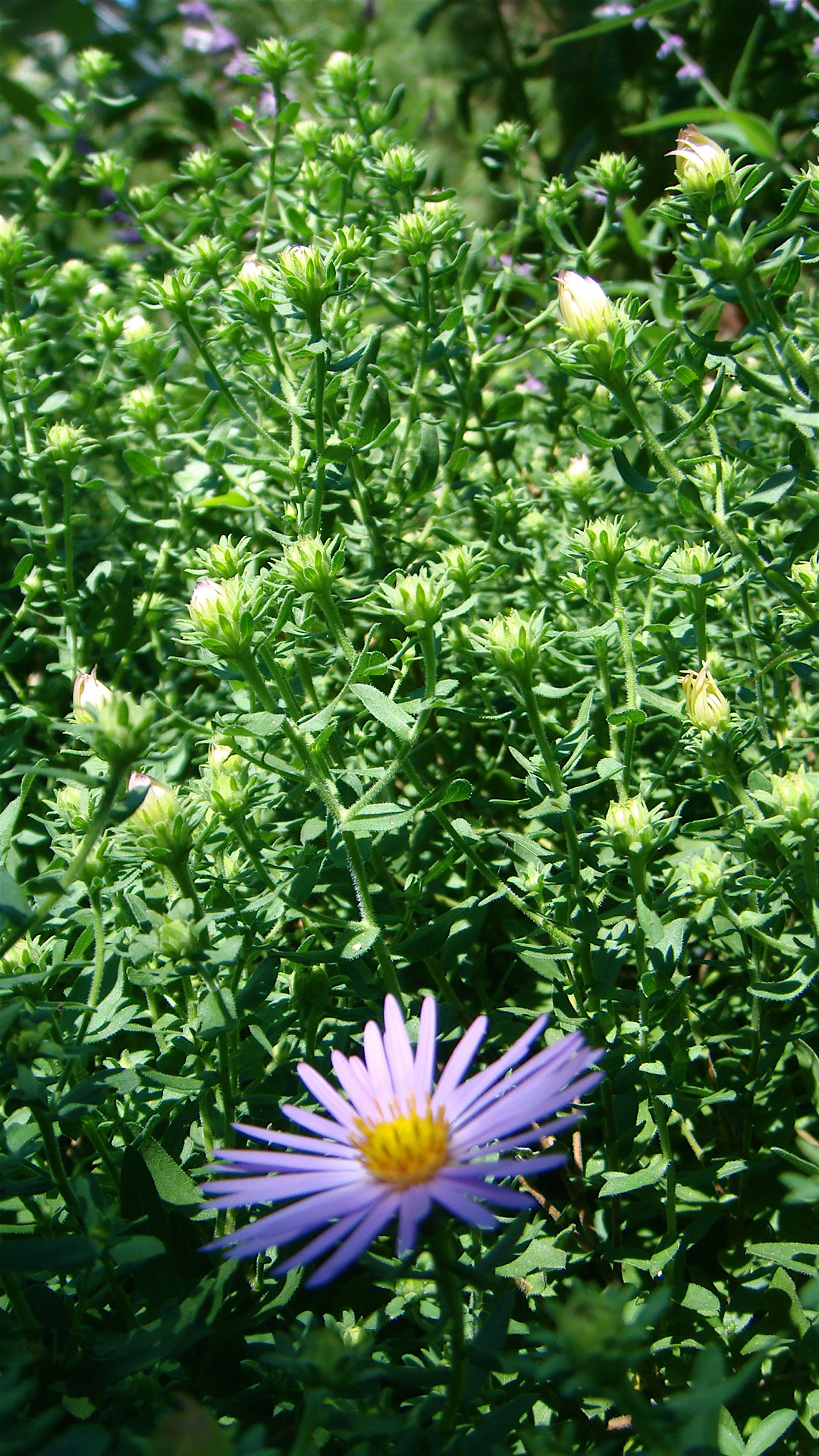 Oh don’t you dare! Don’t be a complete aster…you have to wait another week!
I have my fingers crossed that these short lived fall aster blooms will still be going in the next week or so, after all, we all know how attractive they look after they have bloomed!

Inland sea oats are looking seasonally festive right now.
 The oats got huge this year almost to the point that they are falling over.
Can someone identify this:

A really difficult plant to get a decent shot, this is about as good as it gets!
The next image can only mean one thing…the ESP witches are once again on the move, no doubt gathering herbs and all manner of poisonous plant parts (of which I have many) in preparation for their obscene Halloween shenanigans.

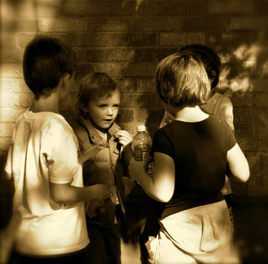
“There was three horrible ladies daddy, sitting on the bench…they looked like “motners”! I knew exactly what he meant, he went on…
“One of them had a big…”



My intuitive eldest also sensed their despicable presence, channeling her concerns into her art as she usually does in such situations.


Finally:
Oh no, I haven’t forgotten!
Did you think you would escape the next “light” installment of the ‘Rime of the Ancient Mariner’ ?
So go grab a bottle of rum, take yet a few deep nautical breaths…here is part two of the slimy, rather depressing mariner’s affair…You better watch it all, there WILL be a written test at the end of the series, oh and a fake gold sovereign for the winner, naturally.
Stay Tuned for:
“The Eve”
 All material © 2010 for eastsidepatch. Unauthorized
intergalactic reproduction strictly prohibited, and
punishable by late (and extremely unpleasant)
14th century planet Earth techniques.