This week I have found many new and old visitors alike taking a flutter or a crawl down the winding decomposed granite pathways in the Patch, and I am not referring to the after-effects of ingesting Leah’s sangria, though I could be.

There are hunters and predators lurking everywhere, under and above leaves, in the sky and on the ground,

Hard to spot hunters hunting down the tastiest foliage, like this…

Texas Spotted Range Grasshopper,
Psoloessa texana
you have to look really hard to spot this grasshopper, even it’s eyeballs are camouflaged! I only ever witness this beast if I happen to disturb one, then I have to follow the enormous jump and endure the subsequent heat and mosquito ravaged hunt in a general vicinity to find it again. They have remarkable colored “flashes” on their legs, that I have still yet to capture on camera. The wings look exactly like leaf skeletons.

“Croak…I love grasshoppers…burp!”
The Gulf Coast toads have been busy in my feeder stock-tank the last few weeks…


…laying strings and floating mountains of toad spawn. I always keep a close eye on the amount of toad spawn in my above ground stock tank pond after my “Primordial Soup” escapade a couple of years back. I still harbor night terrors from that episode and the flatulent machine I rented that was supposed to help alleviate the situation:
http://www.eastsidepatch.com/2008/08/primordial-soup/
And look…

A baby Jewels of Opar! (at least I think it is). Unfortunately it chose a really bad spot to germinate on one of my pathways, I will relocate it when it gets bigger. Considering how many seeds this plant sent out last year I have only seen three new plants so far and they are in wildly different areas of the Patch!

“All this talk of things eating things has made me hungry!”
(Watermelon courtesy of Pam at digging: http://www.penick.net/digging/). I think we can safely say this melon was a total hit with this “Harry” Pam! Needless to say a whole bunch of seeds came spluttering my way seconds after the shutter closed.
This one goes out to you…
“…your the Pam, your the Pam!” :-)

More tiny eggs are turning up on my Mexican lime tree that, incidentally is making a valiant growth effort after I had to take the wood-cutter’s axe to it after the winter freezes. The Giant Swallowtail butterflies swarm citrus trees, giving them their other common name: “Orange Dogs”. The larvae are bird dropping mimics, and retain this nasty presentation into maturity. Because of their camouflage, they can often be found feeding right out in the open on their host plants. I have a bunch of their larvae at various stages of excremental development…

Papilio cresphontes larva
Yes, not the most aesthetically pleasing of creatures I agree, but a very effective deterrent for any would-be predators, after all who would want to eat ….?

 I bet Andrew would also love to get his chops into a few of these brightly colored caterpillars lined up on a skewer! This is the strangely named Io moth caterpillar, I found it lurking in leaves under my ivy.
Automeris io

The feet are very animated.
The larvae start off orange and as they develop turn bright green. The caterpillars are covered in black-tipped spines that cause a lot of pain if touched. It is reported that the Naboo use these spines as poisoned blow-darts on occasion, but that is another story. The spines have a poison that is released with the slightest touch. The green caterpillars have two lateral stripes, the upper one being red and the lower one white. When the caterpillars are ready, they spin a flimsy, cocoon made from a dark, coarse silk. Some larvae will crawl to the base of a tree and make their cocoons amongst leaf litter on the ground, while others will use living leaves to wrap their cocoons with. The leaves will turn brown and fall to the ground during autumn, taking the cocoons with them. Look at what they turn into!

Here are the adult moths female top, male below. (picture courtesy of Wikipedia).
Amazing looking nocturnal moths!
Equally amazing are the

Gulf Fritillary or Passion Butterflies that are now showing up in the Patch
Agraulis vanillae

It is orange with black markings on the tops of the wings. Underneath it has silvery white spots. This one being a lighter orange is a female. I love the contrast topside to underside of these birds, they look like totally different butterflies. Plant a passionflower and watch them turn up!

Incredible coloration.

The Texas Spiny Lizard
Sceloporus olivaceus
is a common resident of most of Texas. It spends a great deal of time on fence posts and in trees like this one in my post oak, searching for food, but can be encountered on rocks or on the ground. This spiny lizard can grow to almost 1 foot in length!

Picture from Wikipedia: pretty fancy!
Colors and patterns typically serve to be adequate camouflage against the bark of trees in its chosen habitat. Their scales have a distinctly spiny texture to them, and their long toes and sharp claws are suited to climbing. I have seen more of these spiny lizards this year then I have ever seen before, not sure why?
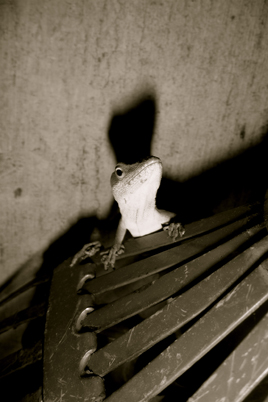
 Unlike anoles who appear to enjoy getting their faces into the camera, these spiny lizards are really easily spooked and extremely fast. This one “galloped” away and up into my post oak before I could say…

“My beans are finally at the top of the poles, and flowering!”…Or…

“Lots of new growth on my purple hearts and fountain grass!”

The Patch is entering the dog days of summer once again,

my fingers are crossed for a more lenient one then last year.
For now the sun is setting in the Patch so I bid you a warm Walton’s goodnight.

“Night Jim Draco Bob, night Pam, night Jenny(s) (RR the kids loved doing the wooden puzzles), night Les, night Daphne, night Germi (it was great to meet you), night Linda, night Meredith, night Texas Deb, night Diana, night Laura, night Cheryl, night Katina, night Ellie…etc,etc.
Stay Tuned for:
“Shaken not Stirred”
All material © 2010 for eastsidepatch. Unauthorized
intergalactic reproduction strictly prohibited, and
punishable by late (and extremely unpleasant)
14th century planet Earth techniques.

Go England!
Check out the Patch write up at: http://www.ci.austin.tx.us/greengarden/award_sanbernard.htm