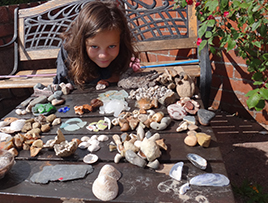
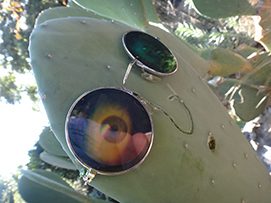
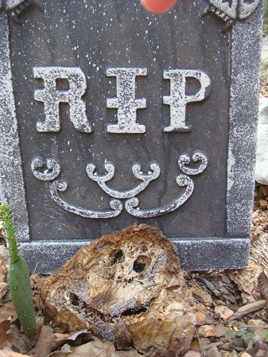
Sitting on her wizened cedar stump (thanks Bob) the local “Patch” seer predicted a hard freeze this week in her crystal ball…

…as night fell she swirled around her fire, occasionally devouring a marshmallow, and a few

blackened shrimps? (Okay that was really bad).

Naturally she was right about the freezes.
 A lone canna leaf, frozen to the spot. The temperatures swing wildly at this time of year in Central Texas, freezing nights contrasting with clear warmer days.

This canna doesn’t seem to know what to do.

Pinecone cactus have decided there is safety in numbers and huddle up close in the cold, check out the face on the winking Mayan-looking character lurking behind the ice plant on the right.
Tephrocactus articulatus

 The rather fearful, grimacing expressions on these cacti indicate exactly how they feel about the cold. The extremities on the “cones” have caved inward in response to the cold night temperatures, though it will totally recover come the spring, with some heat and a few Botox injections here and there.

“Ya ya! Give it to er now ESP, make sure ze has enough left for me esp? ESP? EESSSPPPP?!”
A few plants respond to the cold a little more elegantly, like this very regal Queen Elizabeth Stonecrop,

Sedum spurium ‘Queen Elizabeth’
This little plant just keeps getting better and better, the colder and colder it gets.
 It’s leaves now resemble miniature roses.


This royal succulent can live up to ten years!

“I am not impressed”.


This dwarf miscanthus also looks better as the temperatures dip, its once green leaves now a pin-striped white and purple maroon. I cut these ornamental grasses back to a few inches from the ground in the spring as soon as I see new green growth re-emerging. I see these all around town cut back prematurely, completely missing this purple phase.
Moving on…
The Patch has been hard at work on a residential installation in south Austin, removing a bit of this,
 and a lot of that. I detest unnecessary steel edging almost as much as the Bermuda grass that it invariably attempts to contain, and it is the first thing I usually remove on an install. It really is horrible stuff, overused and invariably badly implemented as a sort of short garden “hurdle” to trip up any unsuspecting person walking in the vicinity. Should you have to remove it? Expect some, or all of the following:
 You can count on being finger-nipped or worse, impaled on one of “Vlad, the Impaler’s” metal spikes, (Vlad reportedly invented steel landscape edging back in the 13th century). I will not mention the language that you will adopt as you work your way down a wobbling unruly line of removed edging, trying desperately to pry and wiggle one rusted or earth-clogged section from another in the most contorted positions imaginable (feet have to be used). It is harder work then shoveling! Oh and if the end of a metal spike has hit a stone or tree root as it was driven into the ground? Forget about it and just resort to bending the two sections together (I have found three sections start to get heavy), though be warned, in a final ditch attempt, this demonic barrier will try to spring up to slap the side of your head with the back of it’s aggressive metal hand. Give me bricks or boulders any day for a less annoying (physically and visually) and infinitely more flexible and naturalistic edging solution.
 Under copious amounts of mulch, I found these ghostly roots tightly interwoven to the underside of the weed suppressant material that we were removing, desperately searching and scouring for a way out from under the smothering black blanket. These roots had traveled staggering distances.
 Amazing…Bermuda grass IS the Borg.
 “YOUR GARDEN WILL BE ASSIMILATED…RESISTANCE IS FUTILE”.
“Oh, but I know your weaknesses Bermuda Queen”.

Oh come on, it is Bermuda grass! Do not talk to me about vinegar and this and that!
Finally:
Cast Iron plant is once again living up to it’s name.


 Soft leaf yucca catching some winter rays.

Ghost plants look their best this time of year.
 One of my favorite clean up jobs!
I love picking up leaves at the best of times as you know, but when they are embedded into the heart of a sago palm?
Well, enough said!
 Stay Tuned for:
“Reflections and Double Agents”
All material © 2011 for eastsidepatch. Unauthorized
intergalactic reproduction strictly prohibited, and punishable by late (and extremely unpleasant) 14th century planet Earth techniques.