The Spice Must Flow!

Remember a couple of posts back when I
was wishing I had earthworms the size
of those found on Arrakis, for aeration purposes?
Well as it turns out our planet Earth also has some fairly
good sized squirmy specimens.
The giant Palouse earthworm

Driloleirus americanus

meaning lily-like worm (when handled it gives off a scent similar to
that of the lily flower). This worm was in the news this week.
Researchers are now scouring the Palouse region (NW US)
with their “thumpers” in hopes of finding more of these giant earthworms.


“I could eat this many”
Andrew, these are an endangered species for crying out loud!
Giant Palouse worms were considered extinct
until a Idaho graduate student Yaniria Sanchez-de
Leon in 2005 stuck a shovel into the ground to collect
a soil sample and found the worm. Little is known
about the giant Palouse earthworm, in fact this
worm has been found only four times
in the past 110 years.


The worm is believed to grow up to 1 m (3 ft) in length.
The worm is albino in appearance and it’s native habitat
consists of the bunch grass prairies of the
Palouse region. The fertile soil consists of
deposits of volcanic ash and rich layers of
organic matter, thought to sustain the worm
during dry seasons. While I was researching this worm,
I found an even bigger earth worm that lives down under, well naturally:


The giant Gippsland earthworm,
Megascolides australis
This slimy friend can get to a length of 2-3 meters (up to 10 feet) and is about 2 centimetres (around 3/4 inch) thick…a monster.
Enough worm talk.

What has been happening in the convection oven I call the ESP this week?
Well I did find a cave of sorts by my pond. I am not sure who, or what made this shelter, but it was made well. It even has its very own pathway leading into it. I have to assume it is the Nananaboo’s up to their shenanigans again, perhaps it is a hunting lodge, perhaps a cooling cave to escape the midday sun?
I did peer into it with a flashlight just to see if there was the remains of food, or perhaps a small moose head adorning one of the walls. Talking of holes in the ground…


an armadillo perhaps? I did hear this week the heat is driving them into the city.


“It is the eyes that blind a man Grasshopper”.
Master Po: Close your eyes. What do you hear?
Young Caine: I hear the water, I hear the birds.
Po: Do you hear your own heartbeat?
Caine: No.
Po: Do you hear the grasshopper that is at your feet?
Caine: Old man, how is it that you hear these things?
Po: Young man, how is it that you do not?


metaphors, I am not even a grasshopper!”
Yes it looks like a grasshopper, it acts like a grasshopper, it sounds like a pasta, but in fact it is a great green bush-cricket
Tettigonia viridi…
…and it is a master of camouflage.
Tettigoniids may be distinguished from grasshoppers by the length of their antenna, which may exceed their own body length, while grasshoppers’ antennae are always relatively short and thickened. This one always had one of its antenna pointing at me at all times, in a creepy, roachy kind of way. (Slight tremble felt in left knee quickly followed by a parching of the mouth?).

Here is the same cricket on one of my burgundy cannas. Look at the length of the limbs!

The Culms are on the rise:
Oh, and how fast they rise! I am just happy this is a clumper as
my entire yard would be engulfed in bamboo in no time. This is
the first year that my giant timber bamboo has produced culms
with this diameter.


Pretty twisted image I know, I thought the baby would give a
sense of scale, instead it just made the scene look rather eerie,
in a “chucky” sort of way.

He still hasn’t got over his infatuation with this newly watered, drippy container.
Even though this thyme is practically fried, I still like to water it just to watch his reaction.
Wow, I really need to weed under here!

This soft leaf Yucca,

Yucca recurvifolia
is laughing in the face of the continuing Central Texas heat wave…
as are my Saw Palmettos

Serenoa repens
I have had mine about three years, (they take forever to grow).
Saw palmetto is a fan palm, eventually they will get up to 3-6 feet but that seems like
it will take an eternity if the current speed of growth is anything to go by (but the best
things come to those that wait). Palmettos are hearty plants, and extremely long lived
(I know I should not have said this because of the blogging killing curse). There are
some palms in the Florida area that possibly 500-700 years old.
“You feeling a bit apathetic today Charlie?
You should give this try this”.
A tonic to the Mayans.

Saw palmetto is used in several forms of traditional medicine.
The palm contains monolaurin, a lipid found in only mothers’
milk and saw palmetto.
The petiole on the palm is armed with fine, sharp teeth or spines,
hence the “saw” in its common name.

Campsis radicans
Flava Trumpet Vine
is blooming right now. The common name for this plant is cow-itch vine and refers to the plant’s ability to produce a skin irritant. Watch were you plant this one, it needs a lot of space. I have mine in partial shade, in an area where it can spread to its trumpets delight. It would bloom more aggressively in full sun. Humming birds love it.
Other strange observations this week…
A Spider?

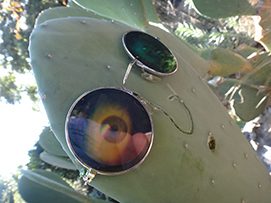
I was doing a spot of weeding in my cactus bed when my attention fell on this.
I immediately panicked and arched backward to get away from it. I felt totally humbled,
when on closer observation, it turned out to be an old pomegranate flower that had
fallen off the tree and caught a hold of this Agave needle.

I looked around, as I habitually do, to see if anyone had witnessed my fit,
(like there would be someone else lurking in my garden,
waiting for this type of thing to happen)?
A Ghost?
I found this new patch of ghost plant haunting the dark, deep down at the
base of this pride of barbados. It is always exciting when something just appears.

And a story book Largus bug nymph

Finally, a few images from a visit to the Mueller development.


He was straight on this slide, though I think he may have personally
underestimated the ultimate velocity, – he flew down this structure.

Click on the second image, he is
completely out of control.

I caught this Band-winged Dragonlet

Erythrodiplax umbrata
in some marginal plants on one of the many ponds at the complex.
The marginal plantings are really impressive, lots of variety.
Here is one plant that caught my eye:

Pickerel rush blue

Pontederia cordata
And lots of very, very, tame fish.

Stay Tuned For:
“Harry Potting Mix“
All material © 2009 for east_side_patch. Unauthorized intergalactic reproduction strictly prohibited, and punishable by late (and extremely unpleasant) 14th century planet Earth techniques.
Inspirational Images of the Week:

Given that most urban cores are already densely built,
this designer proposes an auxiliary series of gardening
structures to be attached to existing structures in downtown areas.