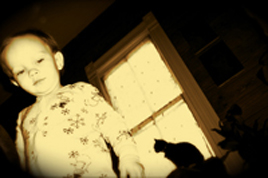
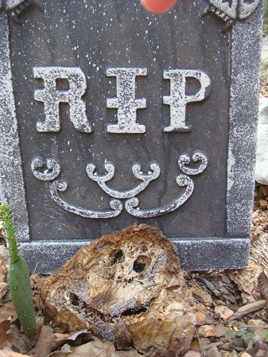
I caught this fiendish grin coughing up seeds all over one of my pathways this morning. I quickly got a tray and stuck it underneath the vomiting seedpod, carefully picking up the seeds that had already been deposited on the decomposed granite.
 Huey…Ralph!
These rather large datura seedpods start off quite hard and green, then they ripen, soften and eventually split, spewing out an enormous amount of seeds in a very drunk “ten pints of lager and a vindaloo” fashion. Oh yes, in a ripened state they are slimy and quite disgusting…but what great hats.
 I picked two or three of these pods smeared them around on my tray and left them to bake in the hot Texas sun. I have never tried to grow datura from seed, but after witnessing one of the finest displays from this plant this year, and the Sphingids it attracted: http://www.eastsidepatch.com/2010/08/wilson/, I am determined to have a lot more of it.
 I know they are poisonous, I know they contain tropane alkaloids, I know I have kids, I know I have them planted next to a mountain laurel that also drops its potentially lethal red beans all around them…What can I say? The Patch is a dangerous place, if the plants don’t get you, the Naboo surely will.
 I have hammered into my children from a very young age what they should avoid doing with certain plants in the garden, and they totally get it, this is one they give a very wide birth, well this, and the mountain laurel, and the oleander, angels trumpet and…
From a crazy grin to some rather irritated eyes…

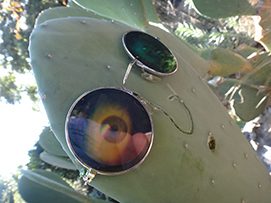
It appears that Cactus man (junior) has developed another slight retinal irritation, just to add to all the drama that he has already had to endure in his resurrected life… http://www.eastsidepatch.com/2009/10/halloween-2009/
 Is it me or is his “small eye” getting smaller? Also, I couldn’t help but notice that he has developed a lot more disturbing lumps on his paddle…(never a good thing).

“You have that right ESP”.
I took my hose and irrigated his eye sockets in an attempt to make him feel a little more comfortable.
On a lighter note:
 Coral Vine
Antigonon leptopus
has started to bloom in the Patch this week. These pink blooms are a staple in southeast Asia for bridal bouquets, it is also known as “chain of love”, probably due to heart-shaped leaves and pink flowers that bees cannot resist. I have a love hate relationship with this plant, it can be very invasive if left to its own devices, and it looks like Hell in the winter, so make sure you let it climb in areas where you can get to, to clear out the old growth…and whatever you do, do not let it get anywhere close to some…

…giant timber bamboo, it would like nothing more then to climb up to the top of these culms, it would scale them in seconds!
 This is the skinny side of the Patch, lots of utilities and ducts, home to my redneck wind chime. It does not look too bad from this angle but lets pan out a little…


There we go!
On the left side a couple of pink jasmine vines lived happily for some years, but last winter’s freezes sadly took care of them, it is now a complete interwoven mess. I could stand on a step ladder for hours unraveling these strands, but I won’t. I intend to replant at the base with some more vines and let them recover the structure…the gardening equivalent of sweeping the tangled mess under the carpet.
The additional carpet of weeds on the floor are completely out of control. While I was in here, weeding on hands and knees, I disturbed a host of unsavory characters that had made the area their home…

I found a few of these large, very grumpy toads, shortly before I felt something else, something cold and much more sinister, slimming its way around my right wrist. I instinctively flicked my arm in my now traditional conniption fashion which, for some reason, brings my right knee up toward my chin and ends with me looking behind me in a dog like fashion! My spasm sent this unsavory creature slapping onto the side of my house…where it unexpectedly stuck.

What on earth!

“Or perhaps not from Earth ESP, have you considered that”?
I zeroed in on the anomaly with my camera set to macro…it was quite shocking!

In a panic I frantically checked my wrist, half-expecting to see a hole where this alien had burrowed, perhaps leaving a part of itself (Ahhh) inside me to grow, ultimately to consume me from the inside, luckily I found nothing.
This is a land planarian,
Bipalium kewense…
…and it was sufficiently disgusting.
 They are grey to brown long flat worms with several dark stripes running down the back. Land planarians thrive in high temperature and humidity, thus they are widely distributed in tropical and subtropical areas. Heads of many land planarians are expanded lunate or tapering to a blunt point. A mouth, which also serves as an anus (shudders), is present near mid-body, these disturbing worms are voracious predators of earthworms, slugs, insect larvae, and like the Naboo (reportedly) are cannibalistic. They are also capable of utilizing their own tissues such as reproductive tissue for food when reserves are exhausted. (repeated swallowing, left knee vibration)

Here is the side alley all cleaned up, well mostly. Now to bide my time before my next granite delivery. An alphonse karr bamboo will be going in, in front of the air conditioning unit to visually hide it from the front of the property.
Now if I can only screen the planarian from my conscious memory, perhaps I will get some sleep tonight?
Stay Tuned for:
“Squeezing Lanterns”
All material © 2010 for eastsidepatch. Unauthorized
intergalactic reproduction strictly prohibited, and
punishable by late (and extremely unpleasant)
14th century planet Earth techniques.

Congratulations on your first week at kindergarten Miss P.