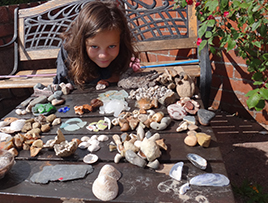
In my last post I wrongly referred to these bleached stones as lava rocks, strange because I knew all the time they were made of limestone, Am I losing my mind, is this how it starts, misidentifying boulders?
A message from Rock rose http://wwwrockrose.blogspot.com/ jogged me to find out more about these rather odd rocks, as it turned out information on them was extremely scarce. I guess these rocks are relatively scarce themselves.

The rocks are called “honeycomb limestone” or Texas “holey rock.” And they are endemic to TX, particularly Central Texas. The rocks are sought after by aquarium enthusiasts and sell on e-bay for a fair amount of money considering they are rocks. Fish apparently love to rest and hide in them, they also help clean the tank water due to the fact they gradually erode in a fish tank over a very long period of time. Coraline Algae also takes on these rocks for one final fishy bonus, as seen in the rocks below:

In nature these rocks take an even longer time to erode, in fact, thousands of years, hence the price tag. They are also hard to locate. They are usually found in pockets and seams, rather like coal. Lime-stone is formed by the accumulation of minerals deposited on top of each other over thousands of years. The distinctive honeycomb appearance, it is believed, forms as the earth moves over them, in effect creating fractures. Seeping rainwater mixes with sulfurous gases in these fractures. It is this which dissolves the limestone, resulting in limestone with a honeycomb of chambers.

For anyone as nerdy as me I did manage to find this u-tube video of someone hunting down these rocks. (I was on the edge of my lazy-boy, eating popcorn, yelling at everyone to shush:)
Look out for “high characteristics” in your holey rocks!

I like the way these white cedar stumps reference the color of the holey rocks.
I have used three of them in the new bed. The one above I used to elevate a gazing ball. That is the soft leafed yucca (the wheezing one) that I transplanted from a container tucked in behind it.

Enough talk of rocks. Is it just me or does this image look like a 1970’s album cover? Today was a magical day in the Patch, for today was my annual “Cattail pull”.


“Huh”?
Rest easy my feline friend.

Cattails are like natures 6ft fireworks, wave them around and get ready for the sparks!


Here are the cattails in my main pond this past summer. When they start to get get crispy around this time of year, the “Cull” begins. a couple of years ago I was a little late with my pruners and this plant drained my pond to the level of my pump (about five inches) my fish barely had enough water to cover their backs! How does a plant drain a pond? Well the stems on this plant fall over and buckle at this time of year, one of them fell in line with my water spout and hung over the edge of my pond. There was about as much chance of this happening as winning the lottery, so naturally it had to happen.
Overnight about 800 gallons had drained out of my pond leaving my pump screaming in agony..never again.

Like pampas seeds I have never had these seeds germinate. If ever they did my gardening days would be finished. My yard would become a dense cattail forest, a machete required to get to my shed etc.etc!
These disintegrating seed heads are readily utilized by birds to line their nest. The downy material also makes great tinder for starting fires and barbecue pits, although there isn’t anything as good as this:
http://www.onelightcharcoal.com/
(shameless plug)
well there isn’t!

Native American tribes also adopted this down to line their Doc Martins and moccasins.

“He neglected to mention our huts, he is losing his mind.”
A puttuckakuan, or “round house,” which is covered with woven cattail mats.


Cattail snow on the ground, well it makes a good substitute for the real thing in Central Texas. Rubbish for tobogganing on though, I tried it last year and badly bruised my tail bone.
As the flower spike is developing in early summer, it can be broken off and eaten, though I must say, I have never been tempted, seems like you would need a whole lot of gravy and lager to wash it down?
In mid-summer, once the flowers are mature, the pollen can be collected and used as a flour supplement or thickener…Cattail bread – now tell me that wouldn’t be a success in Whole Foods!
Quite the versatile plant.

You can see how this plant is so aggressive and invasive in its native wetland environment, an unbelievable amount of seeds. This snow was the result from only about six seed heads…incredible!


moving on…

After pretty much finishing my middle bed (minus some final planting that I have postponed until the spring), my cedar pollen irritated “Eye of Sauran” squinted its red, watering eye over to this little patch of dirt.
This is an area that has been bugging me for well over…mmm, let me see, four years…my feeder tank carbuncle.
I use this tank to dechlorinate water before topping up my main fish pond in the screaming hot Texas summer months, when evaporation is about a foot a minute. This top-up pond has worked out really well for me. The problem with the area was the drop in grade toward the rear of the tank and the semicircular “unfinished” brick placement. It is one of those places that I have never really finished or addressed, just lived with. Enough is enough!
I used the remainder of my decomposed granite from my middle bed delivery to start to flatten out the grade. I then ripped out an old cyprio pump carcass and a couple of guttering downspouts and began making sense of this area, once and for all.

Here it is complete with a backside fill of granite (now that sounds uncomfortable) and completed circular stonework. The stone-crop up on the hill should now be able to work it’s way down the hill and around the stock tank. I will also throw in a few other plants in the spring to echo my new middle bed scheme. The blue herb container picks up on the blue fence I painted earlier last year and the blue fish atop the small hill. My new clumping, variegated, Bamboo ‘Alphonse Karr’ in the background will fill in this area pretty good in a year or two, offering a good color contrast and reflection in the small pond. I am not keen on these Home Depot rocks, I also have the same stones around the perimeter of my papyrus tank. A great idea from “firesprite” to pull the rocks out a little, back-fill and plant creeping sedums, has me thinking what other plants could take this baking? Suggestions?

Other areas of interest in the winter garden:
Strong reds on my Japanese maple look fake against a blue sky.

This container caught my attention today. The low winter sun providing some interesting shadows and contrast.

A snarling agave from the same container. Could the form of this plant look any more aggressive.

It is really strange how agave teeth start out as two dimensional flat sheets.

I had to be careful of the lens on this one.


Cactus tom toms getting ready to bloom and the final saturated
leaves on my amaranth.

Can anyone identify this? some kind of mayfly?

And finally…
It can’t possibly be christmas again already!
A bubline getting ready to bloom.

Breaking wind news! Life on Mars?
Methane belches have just been found on Mars.
This means there is a strong probability
of microbial life or…

The Doctor has gas!
“Hey! even a Time Lord gets it every now and then, it is just
a life saver that the Tardis is bigger on the inside then the outside
if you catch my drift, (although that is not advisable)!”.

Stay Tuned For:
“Silent but deadly”
All material © 2009 for east_side_patch. Unauthorized reproduction prohibited.