"Bamboo Aliens"


“Look Maggy the mainframe has intercepted a sub-space blog posting that indicates that one of our hatch-ling cocoons has been discovered on the, wait one minute, fourth, no the third planet from the sun in the Milky-way system. Set an intercept course immediately”.
“Course laid in Hamish.”


This was the disturbing gooey, alien scene inhabiting
one of my weeping bamboos, and it covered
quite a large area! I have never seen anything
like this before, any ideas anyone?
My best guess is bamboo mealy bug.
I investigated a little deeper into the sticky interior…


And I pulled out what I first thought was a marinated
grilled quail (I always garden in white forensic gloves),
then quickly realized that I needed to make some
serious phone calls.


“Scully this came out of ESP’s
weeping bamboo!”

“I know Mulder, but there is something
even more disturbing you need to see on

ESP’s  front sidewalk, it may be related”…


“I believe everything. And l believe nothing. I suspect everyone. And l suspect no one. I gather the facts, examine the clues… and before you know it, the case is solved!”


Someone had committed a crime on my sidewalk and believe me it wasn’t for the faint hearted.  I applied pressure to the area with one of my digits, but sadly the fruit died in my fingertips.


The interior of the wound looked just a little too life-like for comfort.
My prickly pear dropping a whole bunch of ripe fruit right now.

The Coat of Arms was designed by         A painting of what Tenochtitlan would have looked like
Francisco Eppens Helguera,
a famous Mexican Architect .

The Aztec people were guided by god Huitzilopochtli to seek a place where an eagle landed on a prickly-pear cactus, eating a snake… After hundreds of years of searching they saw a sign on a small swampy island in Lake Texcoco. Their new home they named Tenochtitlan (“Place of the Prickly Pear Cactus”). In A.D. 1325 they built a city on the site of the island in the lake; this is now the center of Mexico City…Amazing!
The plant depicted on the coat of arms is a nopal cactus.


Prickly Pear Cactus have been
a staple food of Native Americans
for centuries. Some
species were introduced into
North America from tropical
America. It is sold in Mexican
markets as “tuna.”
Prickly pear juice can be used to
make jelly, conserve, marmalade
and even poured on salads. And if you
are feeling like a real party animal
mix the juice with 7-Up or ginger ale
and you will have a drink similar to a:


The fruit of prickly pears, also goes by the name of cactus figs or Indian fig,
it has to be peeled carefully to remove the small spines on the outer skin
before consumption.

Oh, one more thing, if your hair is lacking a certain lustre,
the gel-like sap of this plant can be used as a hair conditioner!
You can have a refreshing beverage and condition
your hair at the same time!


The mother plant is so huge now. I keep whacking off the low branches to encourage a higher growth habit. These wooden stems are really deceptive, inside their woody looking exterior lies a relatively soft succulent. The hand saw just glides through these boughs, (it makes a nice change to cut through something, actually anything, with less effort than you thought it would actually take!) an extremely rare phenomenon.


Everything but the kitchen sink! My white-trash rain collection “system” looks really attractive dosn’t it?
Oh, and it is a really easy and fast “system” to set up – no plumbing expertise required!  One day I will get to this!

Yes as you can see, some rain has finally made it to Central Texas this week, and I am not about to waste a drop of it. With temperatures going up and down faster than the stock market, it is hard to tell if we are in summer or winter.
Just before the cold and wet weather arrived I was basking outside on one of my canvas seats watching one of my Harry Potters casting a spell…


“Tillandsia recurvata”! “Aye’s has a very bad feeling about all of this.”

I had my camera tucked between my legs (for what I believed was safe keeping).
After all the “spells” were executed, the light moving to dusk. we got up and went inside.
I awoke during the night to the sound of rain hitting our metal roof, ahh,
I smiled and resumed rehearsing the sea-shanty I was whistling through my nose.
I can’t quite be sure but at one point I think someone joined in for a short duet.

The following morning I was going through my usual routine;  I showered and put on my boots to go feed my fish. This is when I encountered a problem, I never leave the house without my camera, I have learned the shortest journey down my yard (without a camera), always creates the best opportunity for a truly fantastic shot. It is second nature to me now to slip it into my pocket before exiting the house. The problem was my camera was missing…


I scoured all the usual places it generally frequents, the dresser, the bowl, that little shelf that no-body ever uses, nothing. I began to have a really bad sinking feeling. After about half an hour of checking exactly the same places five times, (plus the obligatory peek inside the refrigerator), I glanced out of my window, and with a sort of sixth sense, my eyes fell right on it. I could see it shining on one of the canvas chairs, but what was that reflection above it? Something was terribly wrong.


[Re-Inactment].
It was lying there like an electronic “Ophelia”, submerged under a few inches of our well needed water. I ran outside moaning a dramatic, cinematic, slow-motioned “Noooooooo”! and scooped it from of it’s watery grave. I have no idea what I was thinking, like I could bring it back to life, perhaps it had miraculously survived a cold night under-water?  Ridiculous!
I turned on the oven, wrapped it up and gently placed my little waterlogged piece of technology on a low heat for a few hours. It is now residing on one of our heater vents on the floor where it will stay for the next week or so, on the remote chance it will spring back to life again.


“It can happen!”
Lets go back to where all this started…
Ballmoss…
Tillandsia recurvata


Nerd alert! Nerd alert! Ne…….
I want to take a break from all the drama happening on the East-side and write a little about this mis-understood bromeliad. We all have it, most of us hate it, but its here to stay so lets take an unbiased look at this woven ball of grass.

First of all, ball moss isn’t really a moss at all, but a true plant with flowers and seed. It is a member of the Bromeliad family, so it is related to the pineapple of all things. Ball moss is an epiphyte, (non-parasitic plant living on other plants), similar to many other bromeliads such as orchids, ferns, and my favorites, lichens.
The common assumption is that ball moss is a parasite, sucking and zapping the strength out of healthy trees  like a vampire . Some people also think that heavy infestations of ball moss will cause a tree to decline because leaves can’t get enough light, but ball moss does not like sun, preferring the inner part of the crown of a tree, a place where most leaves are usually dead anyway. These ideas seem to be perpetuated by tree trimmers, oh and do not get me started about leaf-blowers…and time changes!
Most botanists are of the belief that there is no evidence to support any of these fears. It must be noted however, on really heavy infestations a tree may go “into decline” due to the ball moss smothering the buds and limiting circulation to the branch-ends due to the plants circular growth habit. I emphasize here, heavy infestations.


Roots and seed pods. The seeds in these fruits are long gone. The seeds incorporate long hairs which helps them to ride the wind currents and ultimately to stick to something, even chain link fencing!

Ball moss anchors its “pseudo-roots” into the bark, but actually derives no nutrients from the tree, the roots are a securing mechanism only. The plant uses tendrils called “hold fasts” to fasten themselves to branches, and they are extremely effective. It survives by absorbing water and nutrients from the atmosphere. Ball moss “fixes” atmospheric nitrogen and eventually returns it to the soil much like alfalfa and clover plants do. More than likely ball moss does no harm to healthy trees, except to make the “inhabited” trees unsightly in many people’s eyes, for this reason it is generally despised, and aggressively eradicated.
I don’t know if they are still carrying them, but the Big Red Sun used to make some really creative arrangements from these “air” plants.

Poor ball moss! There will always be a “limited” place for you in my post oak.
Besides they make great wands, flamboyant toupees and inexpensive hackysacs.

Some other areas of interest in the patch this wet week…

My Gasteria looking more stomach-like, (and a little flamingo), with every passing day.


The start of a new elephant ear.  Kaboom!


This one always confuses me…is this some type of Lambs Ear?
It pops up sporadically in my yard. It looked pretty amazing today with its furry leaves hanging on to the moisture.


A succulent flower hit hard by the rains.


Lantana blooms.


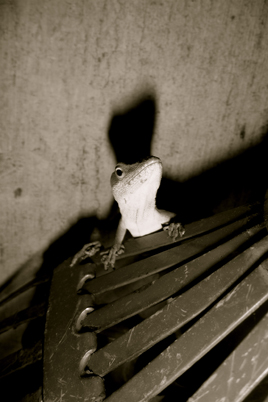
Is this an anole? Is this a mechanism to protect the fly from anoles? To
make anoles think it is an anole? Or is this a load of old anoles?
What do you think?
I believe this is a fire-fly?

The tiniest of succulents in the tiniest of holey rock cavities. Meet Bill and Ben the holey rock men. It is amazing anything can grow in this tiny, elevated spot on the rock, if there is a will, nature will find a way.


A macro marigold resembles a red-hot barbecue.


Another tiny jumping spider, (talking of aliens).

And finally…another wet dusk in the ESP, only this time I have
my camera safe, right in front of me.
Now, where was I, ah yes, my sea shanty!


Stay Tuned For:
“Pushing up the Daisies”
All material © 2009 for east_side_patch. Unauthorized reproduction prohibited.

"Curb Your Enthusiasm"


Bland colors and a lawn butting right up to the house, screamed
out for a smoother transition, well at least a transition.
Some scrappy sages haphazardly positioned around the side-walk.
Is this a new “abstract” planting style I have not heard off?
Out they come.

Here is a property I have been working on in South Austin. The property was about to go
on the market and needed a quick front yard “face-lift”, to give it some extra “curb appeal”.
The budget was limited and the turn around needed to be really fast, basically what can
be done with the minimal of changes, to offer the greatest visual bang for the buck?
My first port of call was a rapid visualization that helped convey the new design intent to
the owner, this was to include a new color scheme for the house, as well as the design
for a front of house, low maintenance bed that I thought would help transition the house
into the rest of the front yard.


For a color scheme, the rust and dark-grey colors on the large cedar tree,
and the white and tan colors of the stone on the house, seemed a natural fit.


A quick sketch to capture the basic plan.


Then some more refined renderings that visualize the new rust and dark-grey color scheme.


Ahh, this brings back a lot of familiar memories. “These are a few of my favorite things”.
A large mound of decomposed granite and a palette of rocks.
My wheelbarrow on viewing this scene defiantly
deflated it’s only tire.


And the final result. The white boulders reference the stone on the house and afford
a more relaxed look. The decomposed granite picks up tan of the brickwork and the roof.

By encompassing the Cedar tree into the bed, the tree now looks anchored and part
of the house, rather than floating in space.


What IS he talking about”?


Two containers in the same color palette, planted up with non-spiky sotols for height
and movement.


I knew those agave pups would come in useful for something!
I spaced four of them around the base of the cedar tree.
Perhaps whoever buys the house will see these babies
mature into the towering yellow beanstalk I witnessed last year.

Moving on to the…

“Hell-Strip”:


Sage and bermuda infestation, my favorite!

This little strip of hell on the same property has really lived up
to it’s reputation. I have spent two days hacking and scraping
at this beast to bring down the grade far enough to allow a
generous portion of decomposed granite to be administered.
Whomever planted these sage bushes just mounded up
some turf on top of the strip and planted! aarghh! The right
picture shows the shrubs pruned back and the soil level brought
down, ready to receive some weed suppressive material and granite.
While I was nibbling and clawing in here I did have a couple of really
interesting close-encounters I want to share with you:


(Insert some Darth Vader breathing) what? How would you write it?
schmeerrrrr…Kufff perhaps?


“Dig lightly we must, the force is strong with this beetle’s mandibles”.

Don’t mess with this Dark Lord, he has a serious attitude problem and some
serious looking pincers. I use one of these beetles as a nut cracker around Christmas time.
This is a Blue-margined Ground Beetle – Pasimachus depressus
and it was big. You can just about see the purple/blue color around the leading edge of the beetle.
It is often mistaken as a stag beetle because of it’s prominent mandibles.


The ground beetle is astonishingly fast, a fact I was painfully aware of with
my lens a couple of centimeters from his prominent jaw-line. The ground
beetle stands high off the ground on sprinters legs, which come in really
useful, as this beetle is a hunting beetle that runs down it’s prey. If the
large mandibles have latched on to one of your digits, most likely this guy
will have also sprayed you with some secretions from his rear-end that
bare no resemblance to the latest fragrance from Calvin Klein…nice!


“Yoda? What is that smell?” ” It is the ground-beetle Luke.”
“The force is strong young Luke.”
“I sense a disturbance in the force.”

“Aw man, Yoda you are strapped to my back!”


My other encounter in the Hell Strip
caused me to involuntarily do a
backward dance reminiscent of
a Scottish jig on the sidewalk as
a recoil mechanism. It would
have looked great in slow motion,
complete with facial grimaces
and a low audible moaning sound.

I had unearthed a Tarantula!


“One step closer ESP and I WILL throw this lump of gravel at you!”
Ctenizidae

Here she is in full-on defensive mode in my wheelbarrow. After I had recovered
from my dance I clambered for the camera and was relieved to find she had
survived the shoveling journey unscathed…all limbs present and obviouslyfunctional.

Okay it was a female trap-door spider.


It is called a trap-door spider because when it enters it’s burrow, it pulls the hatch shut behind it.

Trap-Door Spider, is the common name for any of the several large, hairy,
harmless tropical spiders that nest underground. They make long burrows
in the earth, line them with silk, which they spin, and fashion at the entrance
a bevel-edged, hinged, accurately fitting trapdoor often made of alternate
layers of earth and silk. The upper surface of the door may be covered with
earth or gravel, thus disguising the entrance. The nests of trap-door spiders
are generally in groups. The young hatch in the burrows of their mothers and
live there for a few weeks; they then leave the nest and begin small
underground burrows of their own. Trap-door spiders subsist largely
on ants and other insects.


Females never travel far from their burrows, especially if they have an egg-sac.
During this time, the female will capture food and regurgitate it to feed her spiderlings.
Enemies of the trapdoor spider include certain spider wasps, which seek
out the burrows. They sting the owner and wait for it folks…lay their
eggs (usually one per spider) on its body. No,no,no,no,no!
When the egg hatches, the larva devours the spider alive. Brrrrrrr.
Trap-door spiders are often kept in terrariums as pets, their bites
are painful but not highly toxic.
There are over 60 species of trapdoor spiders.

Thank you Jerry over there at http://www.bugsinthenews.com/ for the extremely
quick ID and interesting information about this spider.

Back in the Patch…

Hardy Yellow Ice Plant Delosperma nubigenum
has started to bloom. This one apparently is not as heat tolerant as some of the
other varieties as it comes from colder higher mountains in S.Africa. Has anyone
had any experience with this one? I am wondering if it makes it through a
Texas summer, or simply turns to dust?


Remember my Gasteria, look at how far it has come on in only a week!
I am interested just how “stomach – like” the blooms actually turn out to be.
They are now separating from the cluster and falling down.


This line of sedum in my middle bed that I transplanted and separated out
of one container is spreading out nicely. I must have got twenty new plants
from this division, some of which I transplanted in between some of my
moss boulders. I plan to continue this process until I have it growing between
all my boulders. My next post will be in ten years time when this task will be finished.


Young salvias are blooming right now.


Ballistic bulbines in my front bed.

Stay Tuned For:
“Bamboo Aliens”
All material © 2009 for east_side_patch. Unauthorized reproduction prohibited.

1 2 140 141 142 143 144 171 172