The weather in the patch of late has been almost perfect (in Texas terms). Warm, sunny, blue-sky days with just the slightest hint of coolness in the breeze, and pleasant, mosquito free (well almost) nights. The evenings are really scented right now from the jasmine vine at the side of my property.
Ahh, if only the temperatures would remain as moderate as they are right now.

Here is my star jasmine, actually I was wrong, here is my Pink jasmine, or Winter Jasmine
Jasminum polyanthum.
(Thank you for the correction Jenny).


…can you spot the sphinx moth, it is not easy.
The leaves of the plants in the jasmine family are used to brew tonic teas and herbal remedies in China. Research indicates that the plant does indeed contain chemical enzymes that function as anti-inflammatories. The flowers of the plant are also used to create jasmine essential oil, they are gathered at night because the odour of jasmine is more powerful after dark. The oil is so expensive because it takes…

“One million flowers”
to produce a small amount of oil.

Moving on to this little brick oven-baked
strip of bermuda grass infested heaven.

Before and after.
Almost done. Sage pruned up, granite layed down, at the property I have been working on.
The “Hell Strip” now requires some feather grass to soften the edges and fill in the planting and perhaps a shasta, or four nerve daisy or five, to add some low maintenance color?


Back at the patch there was also a line of tiny feather grasses about to go into their own low nutrient, decomposed granite home. The mature grasses around the perimeter of the circular bed were planted around this time last year. I am about to dig these up and divide them, I will cut the divisions back to almost the same height as the new ones.

Moving on to some other parts of the patch:
The itchy “Eye of Sauron” cast it’s critical gaze onto
this area of the ESP this past week:


This patch of land has been irritating me for quite long enough. It was the first area in the entire yard I started planting and doing some “improvements” in, over time it has ended up a bit of a hodge podge of living and man-made things. There were bits of fences with lattice nailed to them, old cedar carcasses, and containers randomly strewn around the area buried in lots and lots of ivy. There was even a grumpy old iris crammed up like a criminal, face pushing against a fence (that served no purpose), screaming profanities!

This all needed to go, a clean slate, a fresh start etc.

The fence and lattice monstrosity
was the first thing to come out,
lucky for me I had not cemented
the posts into the ground, they were out
in seconds. I felt better already.

I noticed I had a couple of what I thought were small elephant-ears planted in here that needed to be transplanted. I dug down a little and was amazed to find this massive screaming Taro root (corm).
The plant above the large bulb has rarely got above a few feet in height. Very odd indeed!


I also pulled up a few logs out of the area. This one looked like it had some japanese letters carved into it.
There has been some serious boring going on in here, (no funny comments).


Here is a cedar carcass that was completely covered in ivy.
This one I immediately found a new home for.
I will use this as a planter for some small succulent plants.


I was making good progress, then, through a pile of dead leaves,
I saw an edge of black plastic and remembered exactly
what was buried in here.

No, it was not Spock’s coffin.


It was a large, black, home depot “pond” that I had submerged many years ago as an ill-fated attempt at a bog garden. Over time the whole area went into neglect, the flagstones got covered up with leaves, and eventually everything went out of sight and subsequently out of mind.
Today was to be extraction day.
I had dug it in, now I will dig it out, this time it is destined for the spring bulk pick up (unless that is, anyone wants it)? I will throw in a couple of braces of agaves, what? :-)

Here is the beached whale finally hoisted up onto the pine-bark beach.
There were many critters living under the “pond” that I don’t care to mention (shudders), but one I will …

m m must get out!
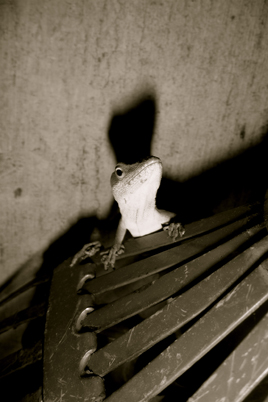
Geckos, lots of them, they had a real hard time getting out of the steep incline with loose soil.
I gave them all a “legs-up” with the tip of my shovel, in defense, one unfortunately dropped it’s tail, a process called autotomy. A mechanism I am happy we do not share. Can you imagine?
Geckos are small to average sized lizards belonging to the family Gekkonidae which are found in warm climates throughout the world. Geckos are unique among lizards in their vocalizations, making chirping sounds in social interactions with other geckos. The name gecko actually stems from the Indonesian work gekok, imitative of its cry.


Last year a gecko, partly preserved in amber for 100 million years, was the oldest fossilized gecko ever found. The amber, began its existence as tree sap, in which the lizard was apparently caught. The find was at least 40 million years older than the oldest known gecko fossil,shedding additional light on the evolution and history of these ancient lizards that tickled the feet of giant dinosaurs. Ironically the only part of this gecko that was preserved was it’s foot.


looking like more screaming mandrake roots, these divisions came from the two plants that were still living in the pond. I must have got twenty plants out of these original two! I am not sure what they are and for now they are dispersed in my Hoja Santa bed.


Here is the area all cleaned up. The clean up also created yet another new pile of leaves that will be added to the compost bins as needed. More on this area in future posts.
Bloomers this week:
“Aw, stop messing about”!
These are the rather elaborate blooms on my Purple-leaf Sand Cherry right now
Prunus x cistena

Small, pinkish, fragrant flowers are followed by blackish purple summer fruits on this slow-growing, multibranched shrub. Foliage is reddish purple. Sand Cherry can reach 6 to 10 feet tall and 3 to 5 feet wide (if you are lucky). If the growth rate on mine is any measure, this will take a very, very long time. Based on my previous post “Bamboo Aliens.”
The image of the “hatchling” has caused
a continuous stream of inquisitive intergalactic travelers
teleporting to the patch this last week.
This cosmonauts “old school” technology really surprised me.


Making a fragrance cocktail with the pink jasmine this year is my small but potent Satsuma tree. The blooms on this tree make your mouth water and it is crammed with honey bees! The blooms on this little tree promise more than the singular (albeit very tasty) fruit it managed to squeeze out last year. http://east-side-patch.livejournal.com/14147.html
Fingers crossed for more this year.
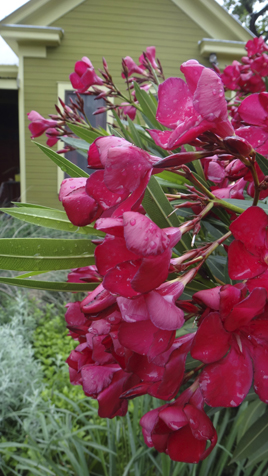
Imagine a full-sun “Hell-Strip” planted up with three of these? mmmm, now that would be different.


Verbena in full-on sprawl mode and bloom. I like the way the form mimicks the Texas holey rocks. The plant fills in every nook and cranny between rocks.


It always amazes me when these little succulent rosettes send up these relatively
enormous flower spikes, this one looking particularly shrimp-like.


Here is another flower spike in the same bed. This one has an interesting
white flower color and shape.


As I was walking away from my round succulent bed I caught a slight
movement in the corner of my eye. I followed this grasshopper for a while
before I managed to obtain these shots. This guy was extremely hard to spot,
having virtually no contrast in it’s body and head coloration. I think this is
brown-spotted range grasshopper (Psoloessa delicatula).


and finally…

An unfurling Gerbera Daisy looks like it would be a great home for “Nemo,” a movie I have watched 18.25 times, (not by choice).

Oh, Just one more daisy…

Stay Tuned For:
“Dr Strange-glove”
All material © 2009 for east_side_patch. Unauthorized reproduction prohibited.