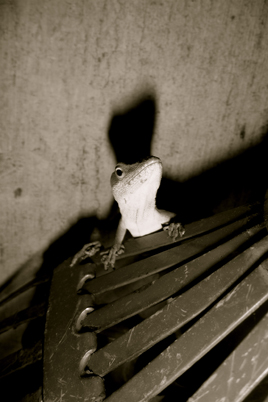
This one’s cloaking device was damaged when it crash landed in a local playground – the “wessle” (as commander Pavel Andreievich Chekov annoyingly immortalised) was about 15ft long. The alien crew communicated via a series of rather annoying high pitched rattles and shrills. I tried to communicate back using similar pitches – but it seems I offended them with my limited grasp of their highly sophisticated language. They turned the nose of their craft to the heavens and immediately hit the “oh please, lets just go button”.


Quote: “These “Humans” are an intriguing race – they are made out of “meat” – they communicate by flapping their “meat” (The Embassidor of the 5th Dynasty of Cicada’s).
“Oh, and a message to the entire fleet: we must exterminate the male known as “Chekov” before he has chance to coin another equally irritating Russian phrase”


http://youtube.com/watch?v=-Dk9z6Ul4X4

If you made it all the way through that link, now you are in the mood!


This type of emergence is reminiscent of an H.R. Geiger movie. I was very happy to capture this private moment on reel, illusive creatures that they are. It is amazing that they actually “fit” into their previous form.


This spider species Argiope aurantia is commonly known as the Black and Yellow Garden Spider or Writing Spider. This female of the species is striking in appearance with distinct yellow and black markings, including banding on the legs. Despite the vivid color, this spider is well camouflaged, blending in easily with partially sunlit areas on the planet Earth.These spiders are not dangerous to people. Yellow garden spiders breed once a year. The males roam in search of a female (nothing new there – garden habitats, bars, night-clubs etc.), building a small web near or actually in the females web, then court the females by plucking strands on her web. Often, when the male approaches the female, he has a safety drop line (think,”Mr and Mrs Smith”) in case she attacks him. After mating, the male dies, and is sometimes then eaten by the female.


No I will Eat Her!       A spider massage is so relaxing, up and to the right a little, yes right there!

Sadly I see less and less of these beneficial spiders in my yard, perhaps as a result of East Austin’s development or perhaps they have found a better planet to inhabit.
I have two other aliens I need your help on . . . this one:


What is this furry guy?
and this one I posted when I first started this blog:


Can you see this master of stealth – really can you? – this was on my Post Oak. It reminds me of :


This guy ! – to much high fructose corn syrup? this is what will happen to you!


I was amazed to see this little guy entertaining on an intergalactic cruise we embarked on some months back, – he has come a long way since since his interior compost pile existence. . . . from rags to interplanetary riches!


His sister also departing to seek her destiny.


This ship has a map inscribed on it’s exterior –  amazing!


Live long and prosper my friends.


Stay Tuned for:

“Gardening in a Furnace”


All material © 2009 for eastsidepatch. Unauthorized
intergalactic reproduction strictly prohibited, and
punishable by  late  (and extremely unpleasant)
14th century planet Earth techniques.


Ok, not really a Nutria but a rather
large rat!


I tried and tried to catch Ratatouille in a picture, but either I would freak out, stumbling and knocking things off my shed shelves, or he would,  bolting up through this grate! I did manage to catch the end of his tail though . . . Ewww!  I considered grabbing the tail with a glove on – then I recounted reading about all those rabies injections into the stomach some years ago in a National Geographic magazine – mmm, perhaps not such a good idea.

I hate to whack the little chap, but I have to. He is slowly consuming my shed and filling it up floor to ceiling with crap. . . . .George Foreman Grills, Swiffers, BowFlexes, Putting aids, self-sharpening sushi knives, Cialis tablets etc, etc  . . . no seriously,  he is filling it with. . .  just crap.


more ewww.

Like dealing with Bermuda grass, I do not mess around here, when my 3 year old says “Daddy, is that a wiggily wrat,” my hand twitches immediately for the green poison sticks strategically positioned on the top shelf with my other instruments and harbingers of death: hornet spray, round-up, man-traps etc etc. Sad though it may be, this is to be Ratatouille’s fate – no culinary education for him I am afraid. I am sure he will give me the pleasure of meeting him one last time, floating like Millais “Ophelia”  in one of my ponds, – his brother did.

I hate using poison, and like the previous “Round-Up” tale, I have tried different “more humane” approaches in the past. My expensive, “reusable” electrical rat exterminator touted a “fast and humane” death for the rodent, – “simply tip up the cage and the electrocuted rodent will just fall into the trash can”. . . . mmm, well not from my electric chamber it didn’t.  I remember going in there with an old metal camping spatula, scraping away until I gagged and ended up throwing the whole thing into the trash. Now I want to change the subject. . . . . . . . . .to. .


this “Brundell Fly”.  It was enormous and spiky, it just sat there, someone please tell me it wasn’t created in a pod with some of Jeff Goldblum’s DNA. I got this Terradactyl off the inside of my front door and onto a piece of paper, I released him outside where he cast a shadow as he flew off with obligatory “swooshing” noise. (The photo does not do scale justice to this beastie). What is this?


Now I really want to change the subject!


Cat-tails get their name from their brown cylindrical flower spikes which can be more than 1 ft. long. They are among the most common of all aquatic and wetland plants anywhere. Cattails grow in dense stands. Like most colonial plants, they arise from rhizomes—thick stems, growing in the mud, usually connecting all the stalks. A cattail stand is like a branching shrub lying on its side under the mud, with only the leaves and blossoms visible.Once fertilized, the female flowers transform into the familiar brown “cigars”—also called candlewicks, punks, duck-tails, and marsh beetles—consisting of thousands of tiny developing seeds. They whiten over the winter after the leaves die, and the cycle repeats. I love this plant – and you cannot kill it! – be sure to keep it in a container though. Looks great in a strong breeze.

Talking of breezes . .


Here is my Cyprus tree that was in a container in my pond – the recent winds blew it over and split the pot – just great!. I am thinking of planting it in the ground – totally the wrong time of year I know, but I think I have to chance it. I need to extract it from the pond immediately – hopefully no fish were under it when it fell!.


Must keep swimming, swimming swimming.
“Ahhh! – the great tree, it falls”


Other things worth a second glance:


Amaranth leaf – all colors of the spectrum.

Beach Vitex in bloom. This plant is causing all sorts of problems
in Carolina right now. As the name implies it grows in the dunes,
crowding out the more naturalised Sea Oats – considered very
invasive in coastal environments. I just bought this, did a little
research, now thinking I need a “Sand Dune” to plant it on – does
it ever end?


Santolina is a
genus of flowering plants in the family Asteraceae, native to the Mediterranean region.
Gray Santolina, has many uses in residential landscapes. Also known as Gray Lavender Cotton, this plant is actually a small shrub, but it acts like a ground-cover and smells like an herb. It offers attractive foliage, small flowers, texture and durability. Properly located in the yard, it has no serious pest or disease problems.
A dwarf form of gray santolina called `nana’ grows to about 1 foot. It is much slower growing, this is what I have – I planted 5 more this spring to offer a wave of silver to my decomposed granite pathway. These are great drought tolerant plants for central Texas – the silver feels frosty even in August! think Mexican Bush Sage in the background, Santolina up front.


View from inside the house looking out to the back yard in what feels like a way too early Texas Summer.

My Post Oak has been a trouper through all the recent high winds, hail and more winds.


Henry Fothergill Chorley-from “The Brave Old Oak”

A song to the oak, the brave old oak,
Who hath ruled in the greenwood long!…

Then here’s to the oak, the brave old oak,
Who stands in his pride alone!
And still flourish he, a hale green tree,
When a hundred years are gone!


Stay Tuned for:

“Texas Bugs are from Outer Space”


All material © 2009 for eastsidepatch. Unauthorized
intergalactic reproduction strictly prohibited, and
punishable by  late  (and extremely unpleasant)
14th century planet Earth techniques.


1 2 163 164 165 166 167 171 172